

Understanding KN95, N95, P2 and Other Face Masks
Face masks became part of everyday life during the pandemic. Today, many people still use masks for work, travel, healthcare, dust protection, smoke, and air pollution. But one question still causes confusion:
What do masks actually filter?
Do masks block viruses? Dust? Smoke? Pollution? Germs? Or all of them?
The answer depends on the type of mask, the material used, how the mask fits, and the standards it follows.
In this guide, we explain:
- Common misconceptions about face masks
- What KN95, N95, and P2 masks actually filter
- What masks do not filter well
- The difference between droplets, aerosols, and pollution particles
- Can KN95, N95, and P2 masks filter COVID-19 and FLU viruses
- Why people get confused about virus size
- The difference between KN95, N95, and P2 masks
If you are shopping for face protection, understanding mask ratings can help you make a smarter buying decision.
What Are KN95, N95, and P2 Masks?
KN95, N95, and P2 masks are called respirator masks. They are designed to help filter tiny airborne particles from the air when worn properly.
Unlike loose surgical masks or cloth masks, respirator masks are made to fit closer to the face. This helps reduce air leaks around the edges.
These masks are commonly used in:
- Healthcare settings
- Construction and industrial work
- Dusty environments
- Smoke or bushfire conditions
- Public transport and crowded spaces
Even though the names are different, KN95, N95, and P2 masks are very similar in filtration performance when certified properly.
What People Think Masks Filter
Many people believe masks work like a solid wall that blocks everything in the air. But that is not exactly how masks work.
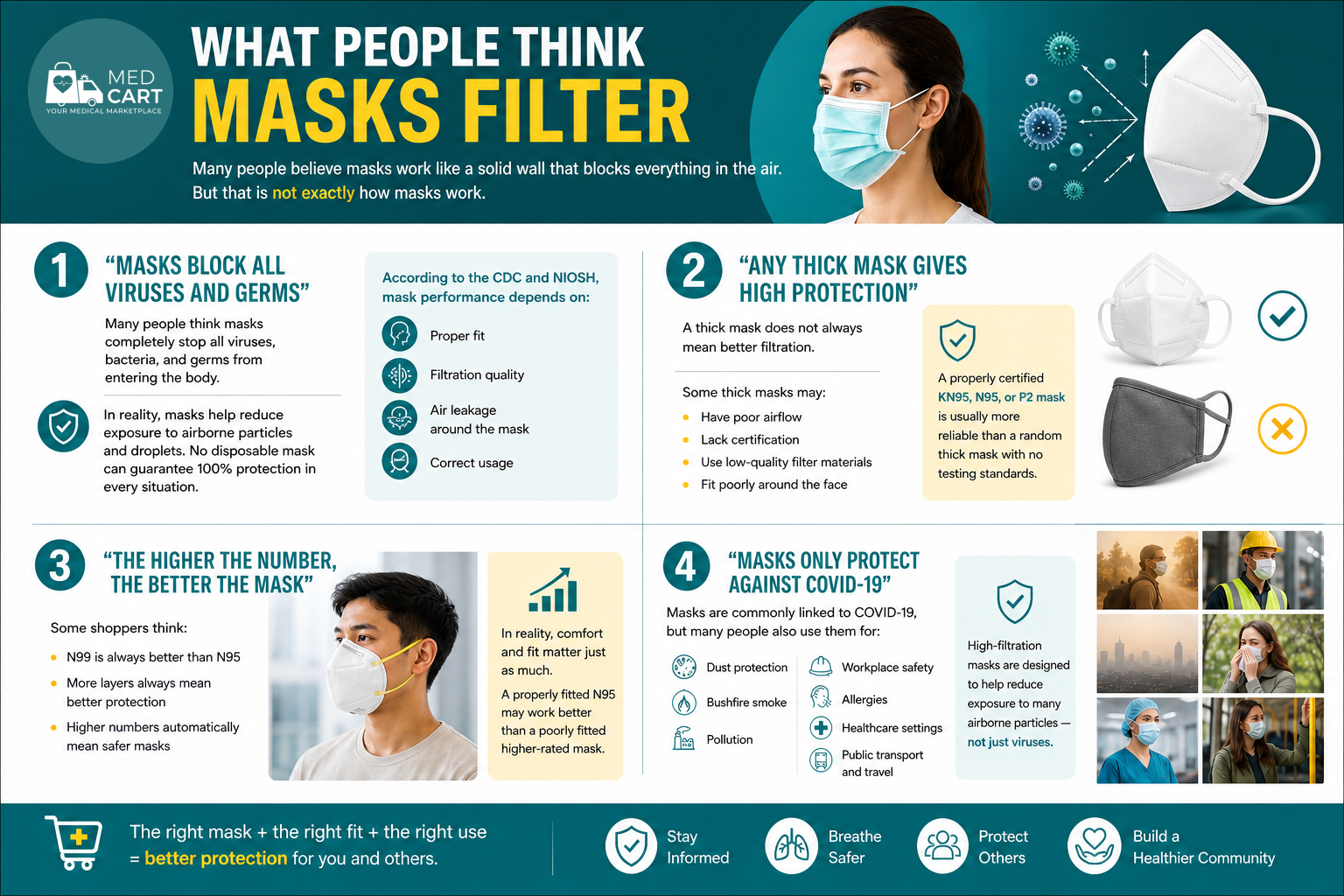
Many people think masks:
- Block everything
- Work perfectly no matter how worn
- Filter gases and chemicals
- Only help during pandemics
But in reality, masks are mainly designed to help reduce exposure to airborne particles, droplets, dust, and aerosols when properly fitted and used correctly.
What Do Masks Actually Filter?
Many people think masks only filter “germs” or “viruses.” In reality, respirator masks filter a wide range of airborne particles.
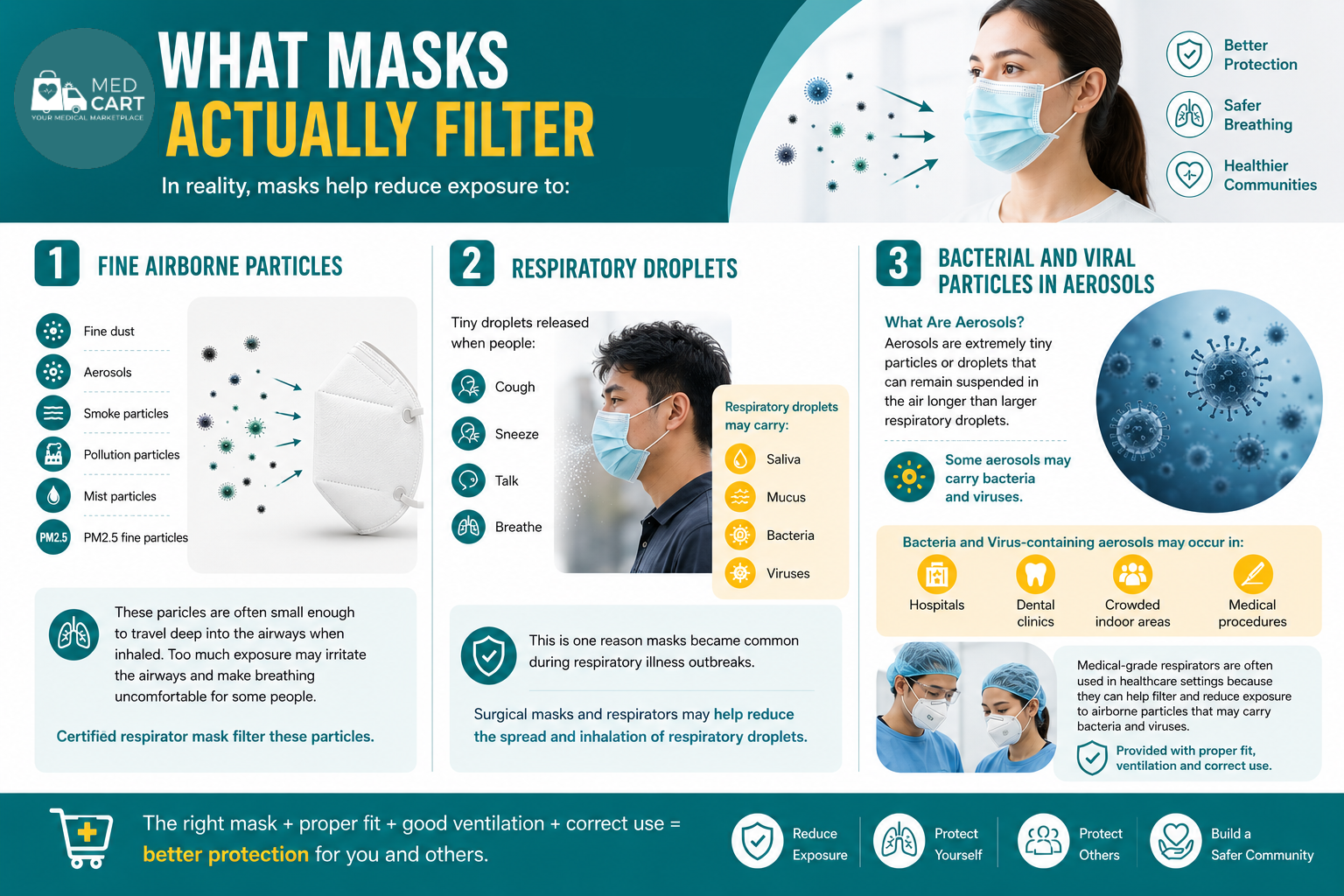
Respirator Masks Can Help Filter:
Fine Airborne Particles
Fine airborne particles are tiny solid or liquid particles suspended in the air. They can come from:
- Fine dust
- Aerosols
- Smoke particles
- Pollution particles
- Mist particles
- PM2.5 fine particles
These particles are often small enough to travel deep into the airways when inhaled. Too much exposure may irritate the airways and make breathing uncomfortable for some people.
This is why respirator masks such as KN95, N95, and P2 masks are commonly used in:
- Dusty workplaces
- Smoke exposure
- Pollution-heavy environments
- Healthcare settings
Respiratory Droplets
Tiny droplets released when people:
- Cough
- Sneeze
- Talk
- Breathe
Respiratory droplets may carry:
- Saliva
- Mucus
- Bacteria
- Viruses
This is one reason masks became common during respiratory illness outbreaks.
Surgical masks and respirators may help reduce the spread and inhalation of respiratory droplets.
According to the CDC and WHO, masks work best when combined with:
- Good ventilation
- Hand hygiene
- Staying home when sick
Bacterial and Viral Particles in Aerosols
What Are Aerosols? Aerosols are extremely tiny particles or droplets that can remain suspended in the air longer than larger respiratory droplets.
Some aerosols may carry bacteria and viruses.
Bacteria and Virus-containing aerosols may occur in:
- Hospitals
- Dental clinics
- Crowded indoor areas
- Medical procedures
Medical-grade respirators are often used in healthcare settings because they can help filter and reduce exposure to airborne particles that may carry bacteria and viruses. Provided with proper fit, ventilation and correct use.
What Masks DO NOT Filter Well
No mask filters everything perfectly. Even high-grade respirators have limits.
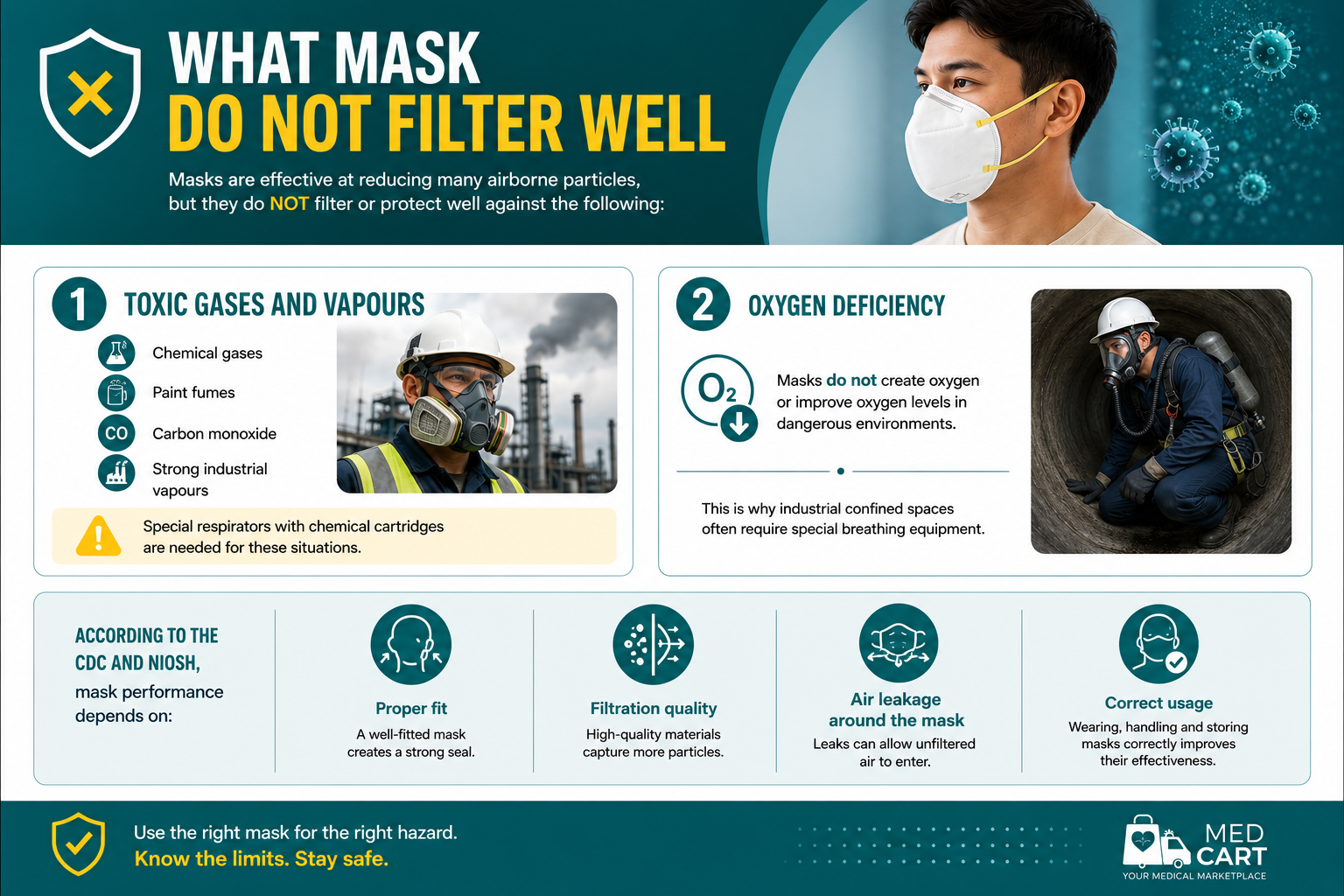
Respirator Masks are not designed for:
1. Toxic Gases and Vapours
Standard KN95, N95, or P2 masks do not protect against:
- Chemical gases
- Paint fumes
- Carbon monoxide
- Strong industrial vapours
Special respirators with chemical cartridges are needed for these situations.
2. Oxygen Deficiency
Masks do not create oxygen or improve oxygen levels in dangerous environments. This is why industrial confined spaces often require special breathing equipment.
3. Poor Mask Fit
Even a high-quality mask may not work well if:
- There are gaps around the nose
- The straps are loose
- Facial hair breaks the seal
- The mask is worn under the nose
Fit matters just as much as filtration material.
Can KN95, N95, and P2 Masks Filter COVID-19 and Flu Viruses?
Yes — KN95, N95, and P2 masks are designed to help filter airborne particles that may contain viruses like COVID-19 and influenza (flu).
But this topic can be confusing because people often compare the size of a virus vs the “filter size” of a mask.
At first glance, it may seem like viruses are too small for masks to filter. But masks do not work like simple kitchen strainers or fishing nets.
Why People Get Confused About Virus Size
Many people read online that:
- COVID-19 virus particles are around 0.1 microns
- Flu viruses are around 0.08 to 0.12 microns
Then they hear, N95 masks filter 0.3 microns particles,
This makes people think, “If the virus is smaller than 0.3 microns, won’t it pass through the mask?” - This is where misunderstandings happen.
Masks DO NOT Work Like a Simple Net
KN95, N95, and P2 masks do not simply block particles based on hole size alone.
Instead, they use multiple filtration methods, including:
- Electrostatic attraction
- Mechanical filtration
- Interception
- Diffusion
These methods help trap very tiny airborne particles — even particles smaller than 0.3 microns.
According to National Institute for Occupational Safety and Health (NIOSH), N95 respirators are tested using particles around 0.3 microns because this size is one of the hardest particle sizes to filter.
Viruses Usually Do NOT Float Around Naked
Another important thing people often misunderstand: Viruses usually travel inside larger airborne particles.
For example:
- respiratory droplets
- aerosols
- mucus particles
- moisture from breathing, coughing, or sneezing
These airborne particles are usually much larger than the virus itself.
So, masks are often filtering:
- virus-containing droplets
- virus-containing aerosols
NOT just single floating virus particles alone.
What Is the Difference Between KN95, N95, and P2 Masks?
Where to Buy KN95, N95, and P2 Masks in Australia
Looking for respirator masks, disposable masks, or healthcare supplies in Australia?
MedCart Australia offers a wide range of:
- KN95 masks
- N95 respirators
- P2 masks
- Surgical masks
- Healthcare PPE
- Medical and workplace supplies
Shop online at MedCart Australia for healthcare, medical, beauty, pharmacy, lifestyle, and business essentials from trusted sellers across Australia.
You can browse masks and PPE categories at:
- KN95 Masks
- N95 Respirators
- P2 Masks
- Disposable Face Masks
- Healthcare PPE
- Infection Control Supplies
References and Sources
- United States Centers for Disease Control and Prevention (CDC)
- National Institute for Occupational Safety and Health (NIOSH)
- Australian Government Department of Health and Aged Care
- Standards Australia / Standards New Zealand AS/NZS 1716
- World Health Organization (WHO)
- European Standard EN149 Respiratory Protection Guidance
- ASTM International Face Mask Standards