
Imagine taking a prescription medication exactly as your doctor instructed, only to receive an unexpected result on a drug test.
Maybe it's for a new job. Maybe it's part of a workplace screening programme. Or perhaps your doctor has requested a routine urine test.
Then you hear the words: "Your drug screen came back positive."
It's easy to imagine the confusion, especially if you haven't taken the substance the test appears to identify.
But here's something many people don't realise: some prescription and over-the-counter medications can interfere with certain drug screening tests.
That doesn't mean every positive result is wrong. It means an initial result may need further investigation before anyone draws a conclusion.
So, can prescription medication cause a false positive drug test? How does a urine drug screen work, and what happens if your result doesn't match your medication history?
Let's break down the science without the confusing medical jargon.
Can Prescription Medication Cause a False Positive Drug Test?
Yes, certain medications can produce a false-positive result on some urine drug screening tests.
Many rapid drug screening tests use a method called an immunoassay. These tests are designed to recognise particular drugs or groups of related substances in a urine sample.
However, some medications or their metabolites may react with the test in a way that resembles the substance being screened for.
This is known as cross-reactivity.
For example, some antidepressants, cold and flu medications, and other prescribed medicines have been associated with false-positive results on particular immunoassay platforms.
But there is an important distinction:
- False-positive screening result: The initial test suggests a drug is present, but a more specific confirmatory test does not detect the target substance.
- Expected positive result: The test detects a drug or metabolite that is genuinely present because of a prescribed medication.
These situations are not the same, and both require appropriate interpretation.
Why Can a Urine Drug Screen Get It Wrong?
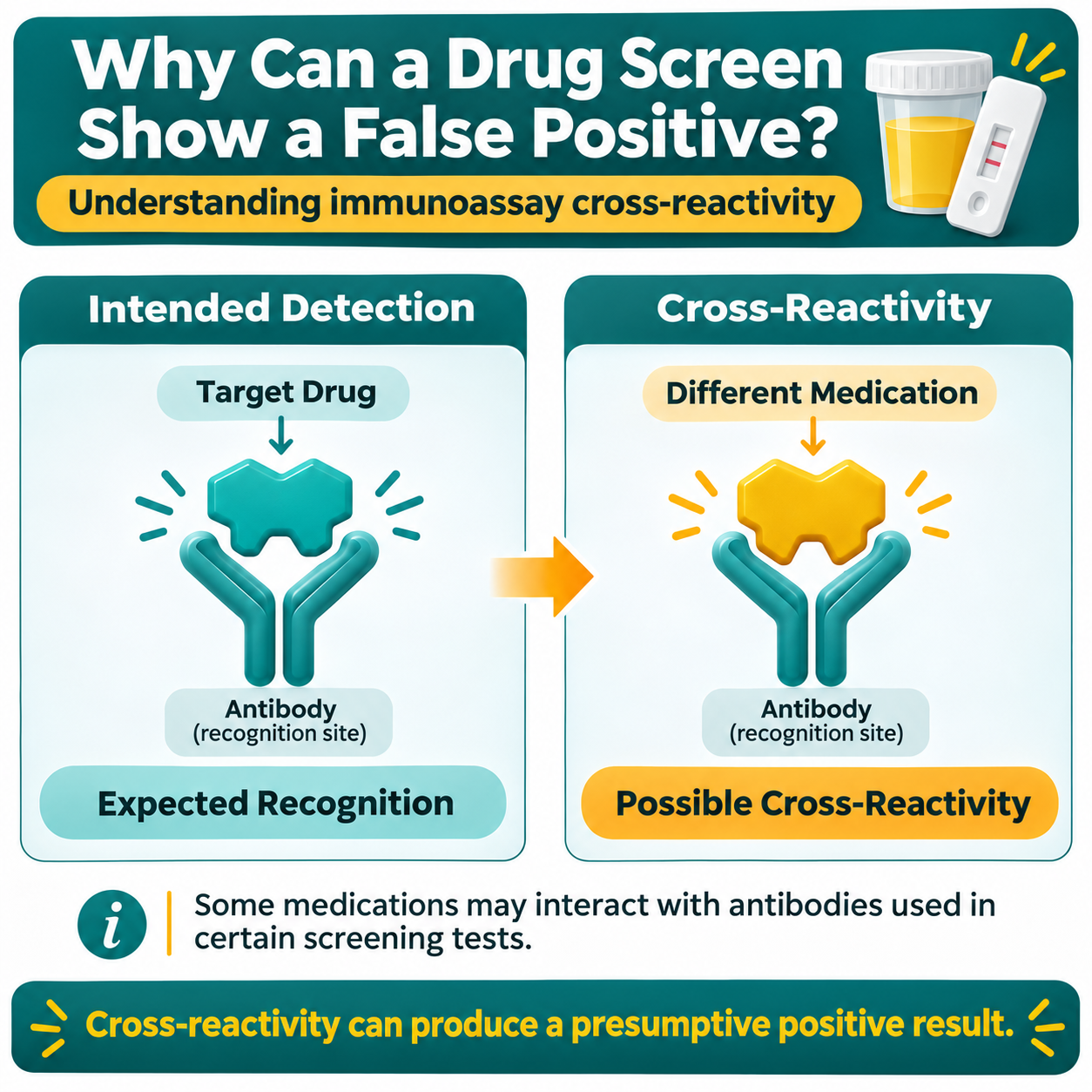
A conventional urine drug screen often uses antibodies designed to recognise specific chemical features of drugs or their metabolites.
Think of it like a security scanner looking for certain patterns. It can identify something that resembles the target, but it doesn't always provide the full picture.
When another medication has chemical features that react with the test's antibodies, the screen may produce a presumptive positive result.
That's why immunoassay screening is generally considered a first step rather than a final diagnosis.
According to Australian Prescriber, immunoassay screening can produce both false-positive and false-negative results, and more specific laboratory methods are used when confirmation is needed.
Which Medications Can Interfere With a Drug Test?
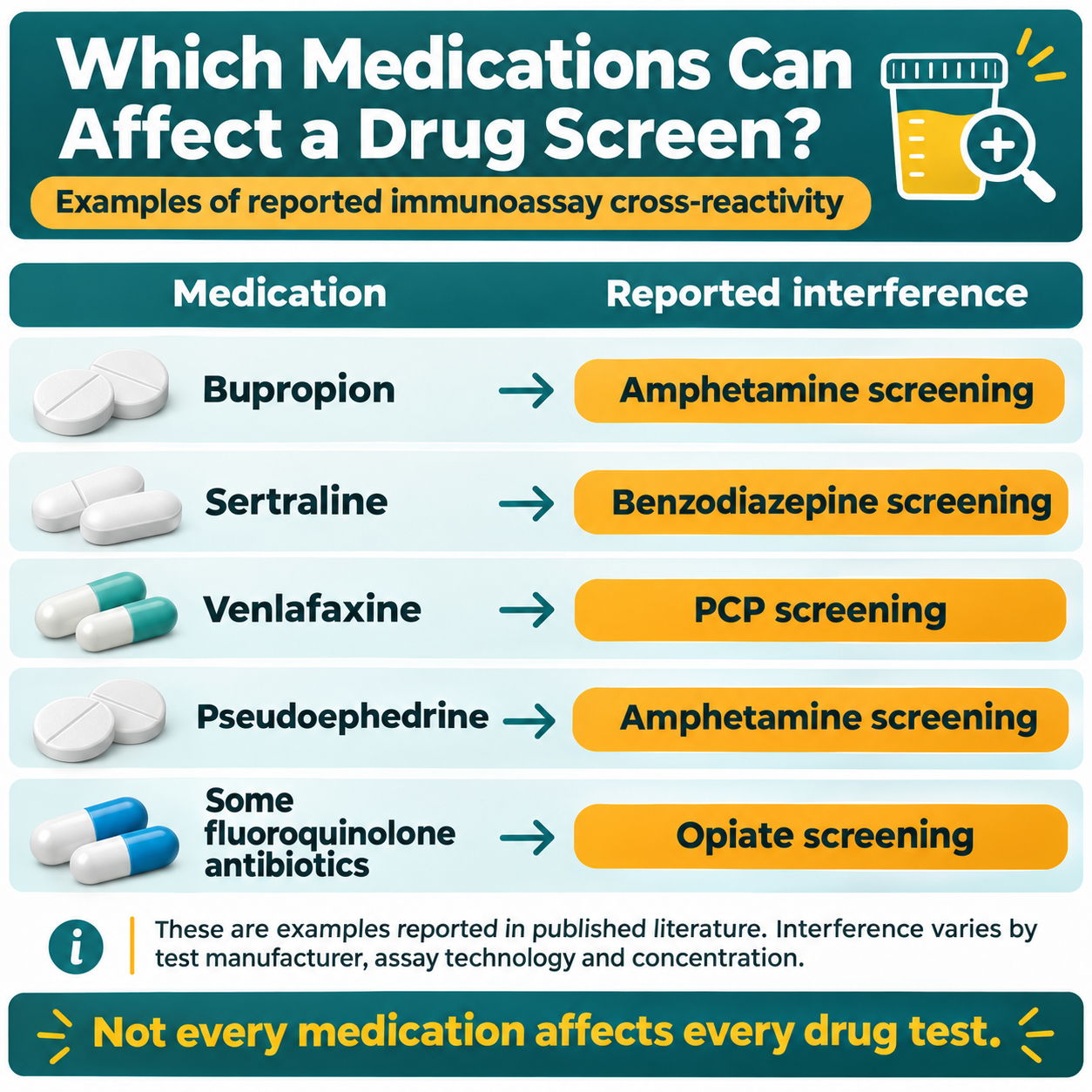
Several prescription and non-prescription medicines have been reported to interfere with certain urine drug screening assays.
However, cross-reactivity depends on the particular test manufacturer, assay design and drug concentration. A medication that interferes with one test may not interfere with another.
Important: This table describes reported analytical interference, not a prediction that taking these medications will cause a positive test. Some older reports involve assay technologies that have since changed.
Never stop, skip or change prescribed medication to influence a drug test. If you have concerns, speak with your prescriber or the testing provider.
What Does a Presumptive Positive Drug Test Mean?
The word "presumptive" is one of the most important terms to understand in drug screening.
A presumptive positive means the screening test has produced a result consistent with a particular drug or drug class being present at or above the test's reporting threshold.
It does not automatically prove which specific substance caused the result.
For example, a rapid screening device may indicate an amphetamine-class result without establishing whether the finding relates to a prescribed medicine, another substance or cross-reactivity.
Further testing and a review of the person's medication history may be necessary.
This distinction is especially important when a result could affect employment, medical treatment or legal proceedings.
Screening vs Confirmatory Drug Testing: What's the Difference?
Not all drug tests provide the same level of information.
A rapid urine drug screen is useful for preliminary testing, while laboratory confirmation uses more specific analytical methods to identify particular substances.
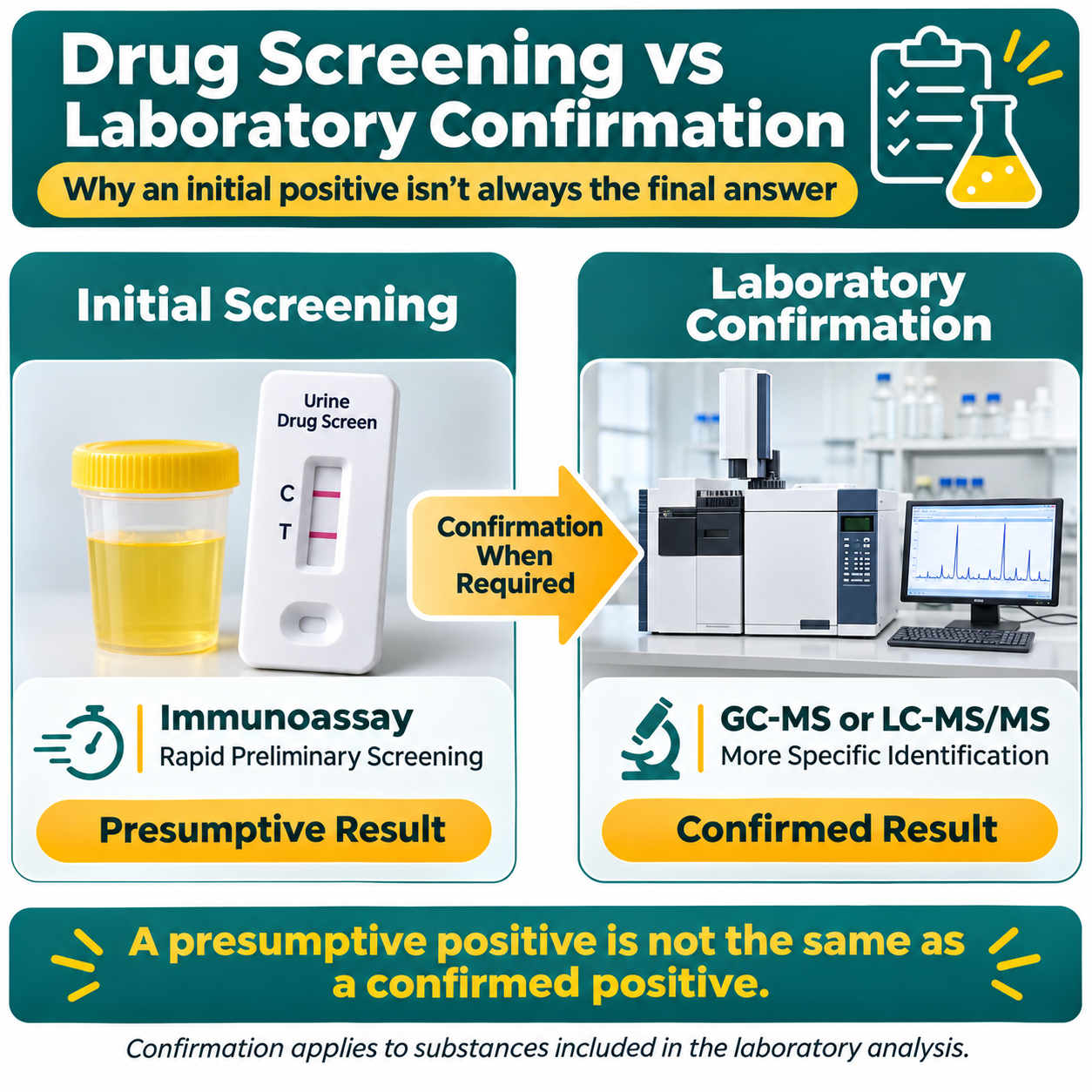
Laboratory confirmation commonly uses gas chromatography-mass spectrometry (GC-MS) or liquid chromatography-tandem mass spectrometry (LC-MS/MS).
These techniques can distinguish particular substances more reliably than a broad immunoassay screen.
However, confirmation only addresses substances included in the laboratory's testing method. It does not automatically identify every possible drug.
What If Your Prescription Medication Is Supposed to Show Up?
Not every positive drug test involving prescription medication is a false positive.
Some medicines contain substances that drug screening panels are specifically designed to detect.
For example:
- Prescribed dexamphetamine: May produce an expected amphetamine-positive result.
- Codeine-containing medicines: May produce an opiate-positive result, depending on the test and timing.
- Some prescribed benzodiazepines: May be detected on a benzodiazepine screen, although detection varies by drug and assay.
In these situations, the detected drug may genuinely be present because of legitimate medical treatment.
A positive result alone cannot determine whether a medicine was prescribed, taken appropriately or misused.
That's why medication history and professional interpretation matter.
Can a Urine Drug Screen Also Produce a False Negative?
Yes. A false-negative drug test occurs when a substance is present but the screening test does not detect it.
This may happen because:
- The drug is not included in the test panel.
- The concentration is below the detection threshold.
- The sample was collected outside the test's detection window.
- The immunoassay does not reliably recognise that particular drug or metabolite.
For example, some standard opiate immunoassays may not reliably detect certain synthetic or semi-synthetic opioids without a specific test.
Similarly, some benzodiazepine screens may miss particular prescribed benzodiazepines.
A negative result therefore does not necessarily rule out all drug exposure.
What Should You Do If You Receive an Unexpected Positive Drug Test?
If you receive a positive result that doesn't match your medication history, avoid assuming the result is final.
Consider these practical steps:
- Ask whether the result is preliminary. Find out whether it came from an immunoassay screen or a confirmatory laboratory test.
- Provide an accurate medication list. Include prescription medicines, over-the-counter products and supplements, following the testing provider's disclosure procedures.
- Ask about confirmatory testing. If the result is unexpected, ask whether a more specific laboratory analysis is available or required.
- Request professional interpretation. A healthcare professional, laboratory specialist or appropriately qualified medical reviewer can help assess the result.
- Follow the relevant testing procedure. Workplace and other formal testing programmes may have specific requirements for specimen handling, confirmation and result review.
Do not discontinue prescribed medication simply because you're worried about a drug test. Discuss any medication concerns with your treating healthcare professional.
Are Home Urine Drug Tests Reliable?
Home and point-of-care urine drug screening products can provide convenient preliminary information when used according to their instructions.
However, reliability depends on the test's design, the substances included in its panel, specimen quality and correct interpretation.
Rapid screening devices cannot replace confirmatory laboratory testing when an unexpected result needs to be resolved.
When comparing products, check:
- Which drugs or drug classes the test detects.
- The sample type and collection instructions.
- The manufacturer's stated detection thresholds.
- The recommended time for reading the result.
- Whether the test is intended for preliminary screening only.
For formal workplace or legal purposes, follow the applicable collection, chain-of-custody and laboratory testing requirements rather than relying on a home test.
You can explore urine drug screening products at MedCart Australia and compare the intended uses and specifications of available products.
Frequently Asked Questions About Medication and Drug Tests
Can prescription medication cause a false positive drug test?
Yes. Certain medications can cross-react with some urine drug screening immunoassays, causing a presumptive positive result that is not confirmed by more specific laboratory testing. The risk depends on the medication and the particular test used.
Which medications can cause a false positive for amphetamines?
Some medications, including bupropion and certain decongestants, have been associated with false-positive amphetamine screening results on particular immunoassays. This does not mean they will affect every test. Confirmatory laboratory testing is needed to clarify an unexpected result.
Does a positive urine drug screen mean someone has taken illegal drugs?
No. A positive screen may reflect prescribed medication, other drug exposure or analytical cross-reactivity. A screening result alone cannot establish whether a substance was taken legally or illegally.
What is the difference between a presumptive positive and a confirmed positive?
A presumptive positive is an initial screening finding. A confirmed positive is supported by a more specific laboratory method that identifies the substance being tested for.
Can a drug test be negative even when someone takes prescription medication?
Yes. A test may not include the prescribed drug, may have limited sensitivity for it or may be performed when its concentration is below the detection threshold.
Should I stop taking medication before a workplace drug test?
No. Do not stop or change prescribed medication without medical advice. Follow the testing provider's instructions for disclosing medications and ask how unexpected results are reviewed.
Final Thoughts: A Positive Drug Screen Isn't Always the Full Story
Receiving an unexpected positive drug test can be confusing, especially when you're taking medication as prescribed.
But a rapid urine drug screen is designed to provide preliminary information, not necessarily a final answer.
Some medications can interfere with immunoassay results, while others may legitimately be detected because they contain a drug included in the screening panel.
The most important takeaway? A presumptive positive result should be interpreted in context, with confirmatory laboratory testing when appropriate.
Understanding how drug screening works can help patients, employers and healthcare professionals avoid unnecessary assumptions and make more informed decisions.
Explore Urine Drug Screening Products at MedCart Australia
Whether you're researching testing options for a clinical setting, workplace programme or another appropriate screening application, understanding the intended use of each product is essential.
At MedCart Australia, you can browse urine drug screening products from independent retailers and review available product specifications.
Always follow the manufacturer's instructions. Rapid screening results are preliminary and should not be treated as a substitute for professional laboratory confirmation where required.
References
- Australian Prescriber. Urinary drug screening. Read article.
- Royal College of Pathologists of Australasia. Drugs of abuse screen. View pathology guidance.
- Kale N. Urine Drug Tests: Ordering and Interpretation. American Family Physician. 2019. Read clinical review.
- University of Illinois Chicago, Drug Information Group. What drugs are likely to interfere with urine drug screens? 2021. Read medication interference review.
- Fasinu PS et al. Analysis of Electronic Health Records Reveals Medication-Related Interference on Point-of-Care Urine Drug Screening Assays. Read research.
- American College of Medical Toxicology. Interpretation of Urine Opiate and Opioid Tests. Read position statement.