Introduction
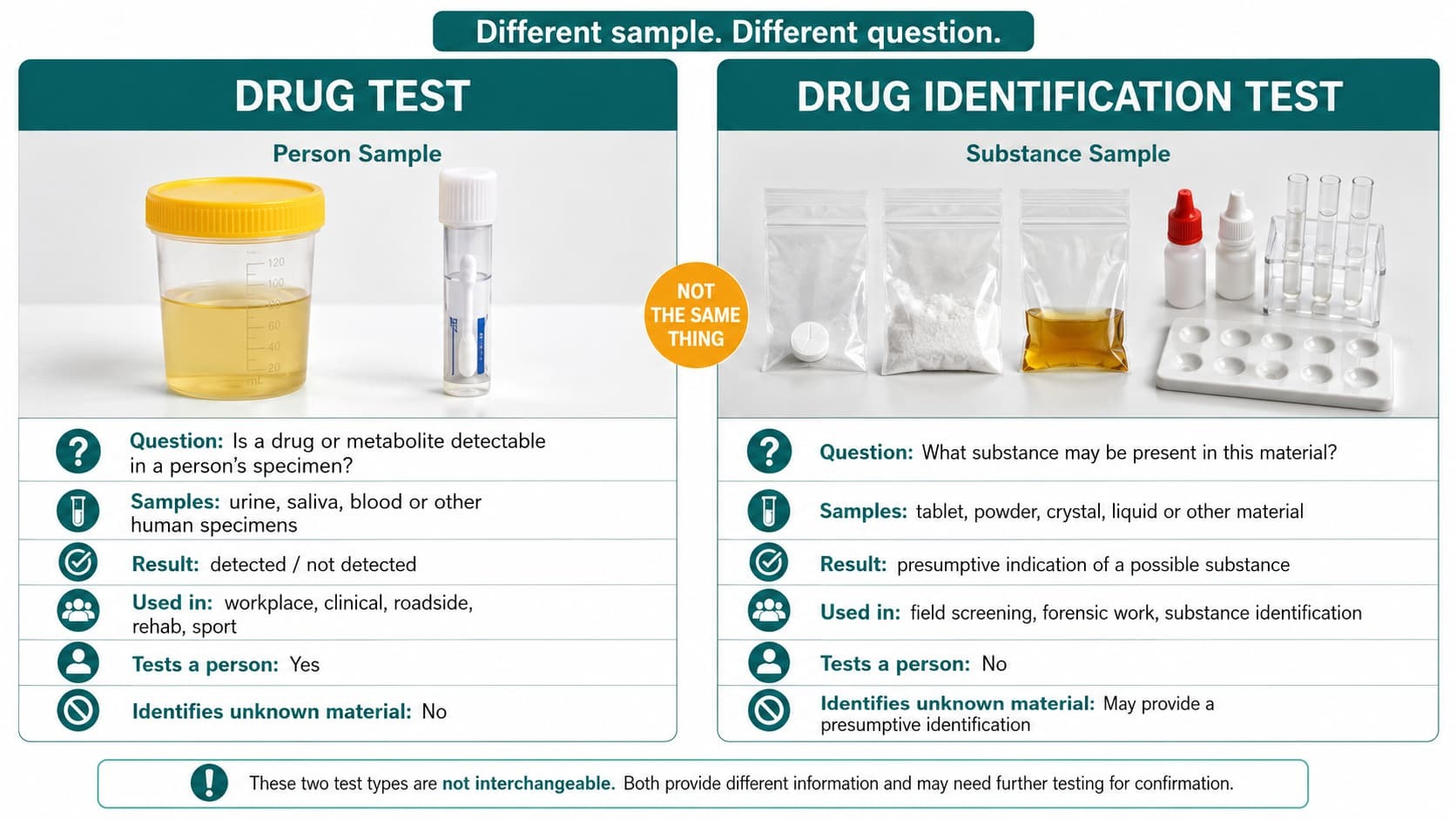
The terms drug test and drug identification test sound similar. However, they answer two very different questions.
A drug test usually checks a sample from a person, such as urine or saliva. It looks for a drug, a drug group or a substance the body makes after processing a drug.
A drug identification test checks the actual material itself. This could be an unknown powder, tablet, crystal or liquid. The aim is to find out what substance may be present.
Knowing the difference matters when choosing a test kit. The correct test depends on the sample, the question being asked and how the result will be used.
This guide explains the difference between drug test kits and drug identification test kits, their limits and when further testing may be needed.
What Is a Drug Test?
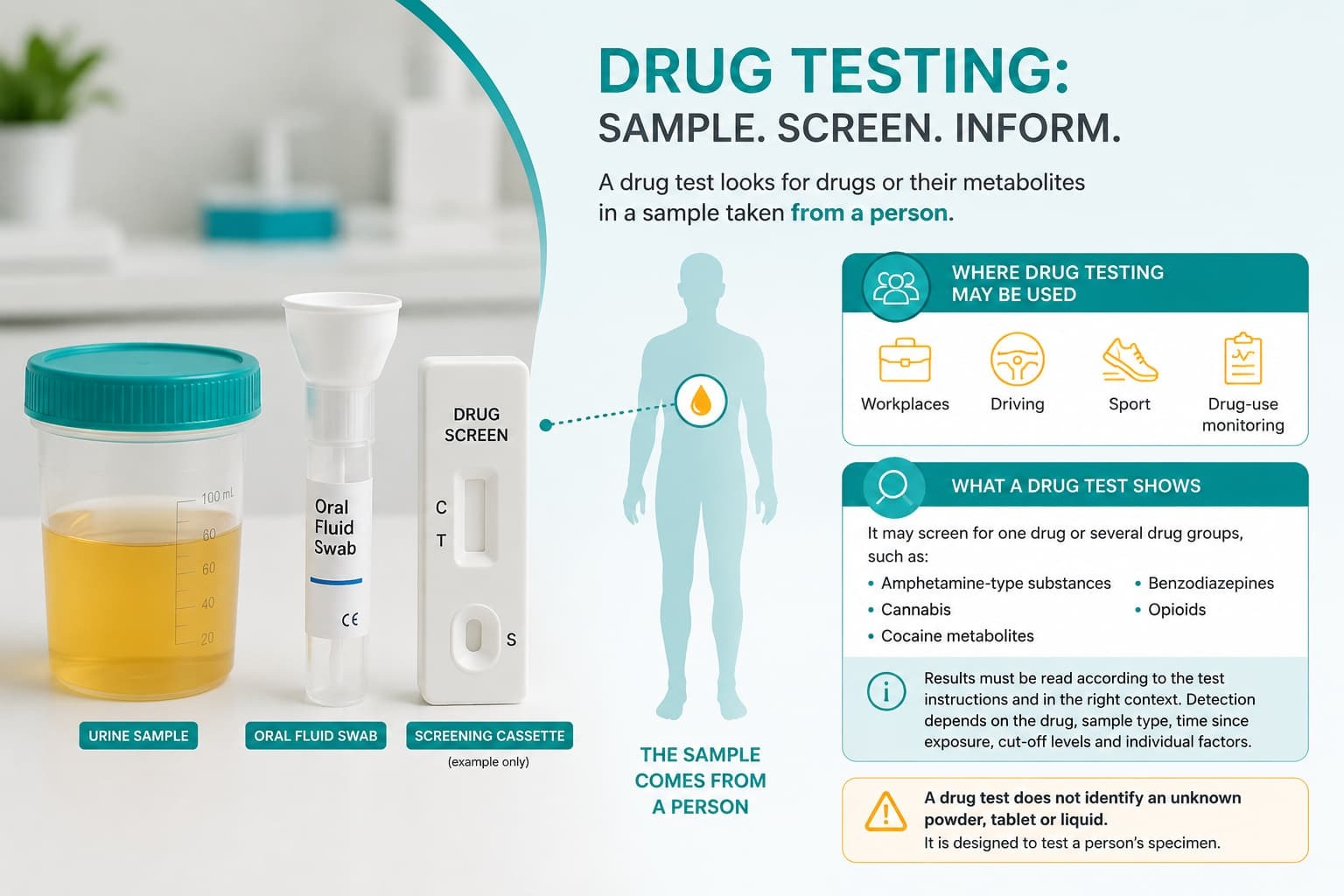
A drug test looks for drugs or their metabolites in a biological sample taken from a person.
The Australian Government Department of Health, Disability and Ageing says drug testing may be used in settings such as workplaces, driving, sport and drug-use monitoring. Samples can include urine, saliva, blood, sweat and hair.
For quick screening, urine and oral fluid are common options. Healthdirect notes that simple urine drug tests may be used at home, in workplaces or in sporting settings. More complex testing can be completed by a laboratory.
What does a drug test show?
Depending on the product, a drug screening test may look for one drug or several drug groups. Examples can include amphetamine-type substances, cannabis, cocaine metabolites, benzodiazepines and opioids.
A screening result should always be read according to the test instructions.
The result also needs context. Different drugs remain detectable for different periods. The type of sample, time since exposure, test cut-off and individual differences can all affect whether a substance is detected.
A drug test does not identify an unknown powder, tablet or liquid. It is designed to test a person's specimen.
What Is a Drug Identification Test?
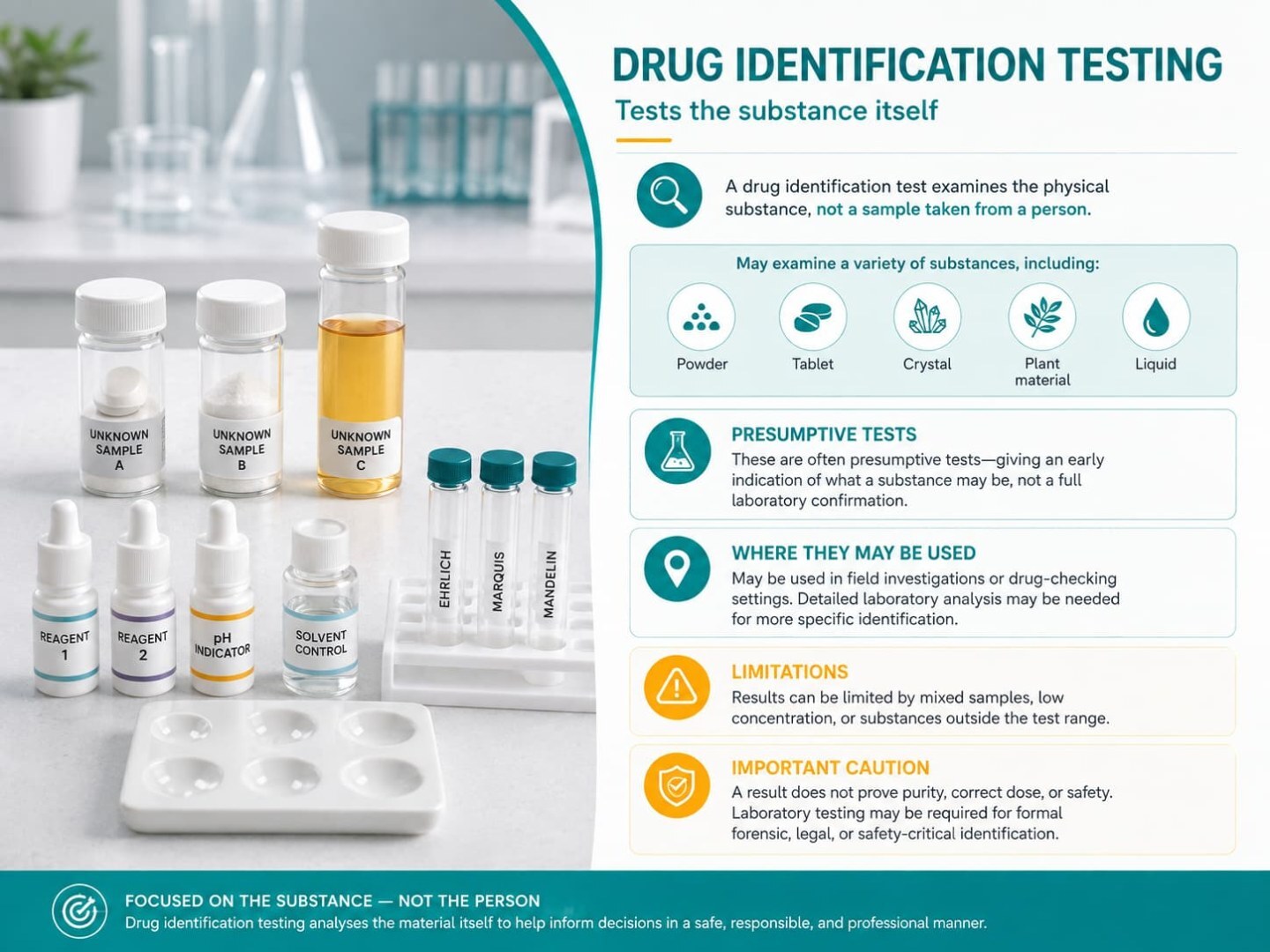
A drug identification test examines the substance itself rather than a sample taken from a person.
The sample may be a powder, tablet, crystal, plant material or liquid. Depending on the test, a chemical or analytical reaction may give an indication of the type of substance that could be present.
These tests are often described as presumptive tests. Presumptive means the result gives an early indication rather than a complete laboratory confirmation.
The US National Institute of Standards and Technology explains that presumptive identification is used in settings including field investigations and drug-checking services. More detailed laboratory analysis may then be used when a more specific identification is needed.
This difference is important. A basic drug identification kit may have limits when a sample contains several substances, has a low concentration of the target substance or contains a substance outside the test's detection range.
A result also should not be treated as proof that an unknown substance is pure, correctly dosed or safe to consume.
For formal forensic, legal or safety-critical identification, laboratory testing may be required.
Drug Test vs Drug Identification Test: Key Differences
The easiest way to understand the difference is to look at what is being tested.
For example, a urine drug test could screen a person's urine for cannabis metabolites. It cannot tell you whether an unknown tablet contains cannabis or another substance.
In the same way, a drug identification test used on an unknown powder cannot show whether a person has used that substance.
The two types of test are therefore not interchangeable.
Screening, Confirmation and Choosing the Right Test
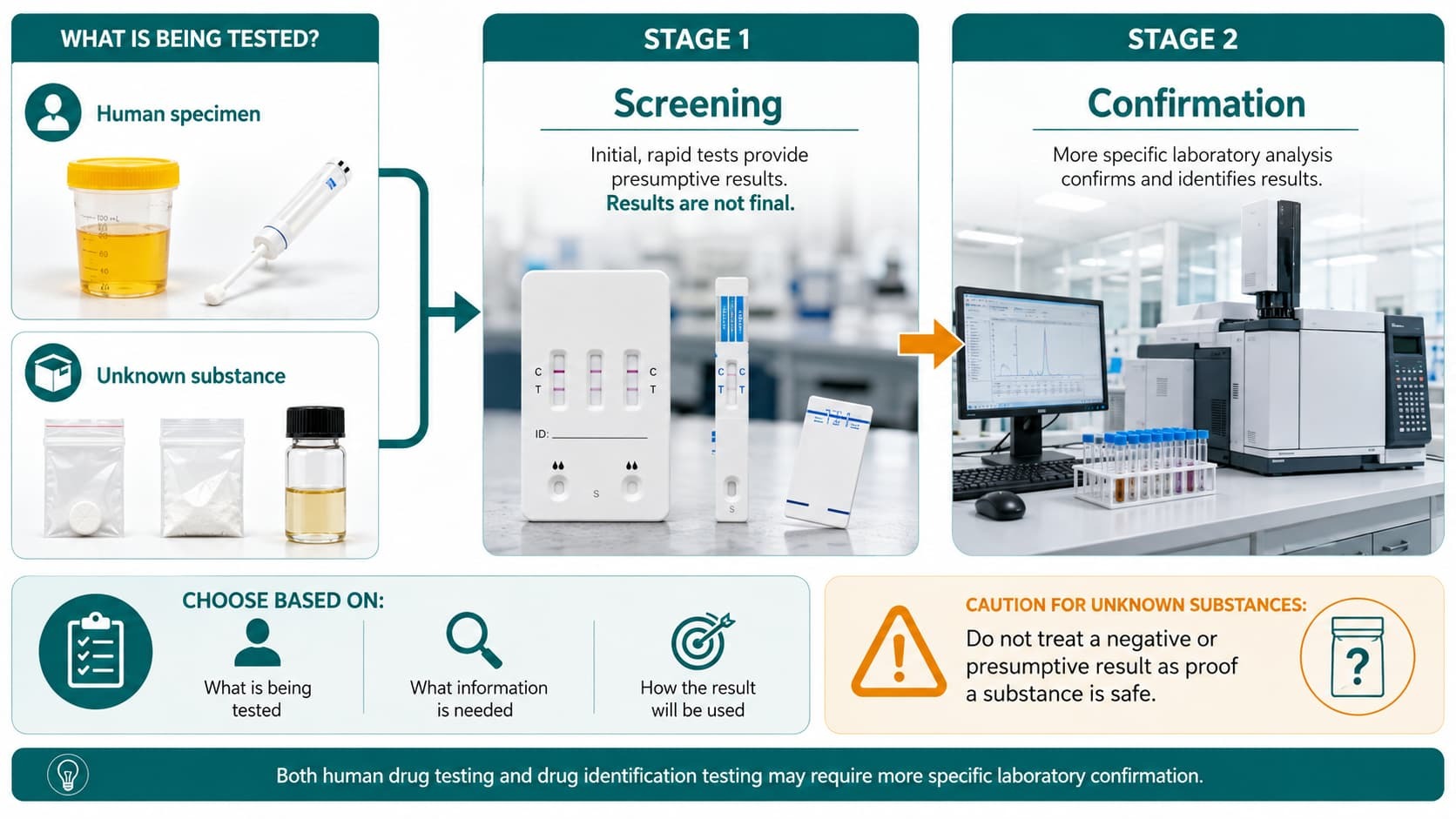
Both types of testing can involve an initial screening step. This does not always mean the result is final.
For human drug testing, Australian testing frameworks set procedures for some workplace and medico-legal testing. The National Association of Testing Authorities, Australia (NATA) refers to AS/NZS 4308 for urine testing and AS/NZS 4760 for oral-fluid testing when accrediting relevant onsite screening services.
NATA also notes that facilities performing medico-legal urine testing are transitioning to the current AS/NZS 4308:2023 standard.
Where a drug test is considered an in vitro diagnostic medical device, the Therapeutic Goods Administration says IVDs examine specimens taken from the human body. Unless exempt or excluded, IVDs must be included in the Australian Register of Therapeutic Goods to be legally supplied in Australia.
Drug identification testing has a similar distinction between screening and confirmation. A presumptive test can provide useful early information, but a more specific laboratory method may be required to confirm the exact substance.
How do you choose?
Start with three questions:
- What are you testing? A person's specimen or an unknown material?
- What information do you need? Screening or formal confirmation?
- How will the result be used? Personal information, workplace screening, clinical care, legal action or forensic investigation?
For workplace, legal or medical decisions, follow the relevant Australian rules, workplace procedures and professional testing requirements.
For unknown substances, do not treat a negative or presumptive result as proof that the material is safe. Follow the manufacturer's intended use and handling instructions.
FAQs
Are drug test kits and drug identification test kits the same?
No. Drug test kits usually analyse a biological sample from a person. Drug identification test kits analyse the physical substance itself.
Can a urine drug test identify an unknown tablet?
No. A urine drug test is designed for urine. An unknown tablet requires a test designed for substance identification.
Does a positive drug test prove a person is currently impaired?
Not necessarily. Drug tests detect specific drugs, drug groups or metabolites according to the test method and detection threshold. Detection should not automatically be treated as a complete measure of current impairment.
Can a drug identification kit tell you how pure a substance is?
Many simple identification kits are designed for presumptive screening rather than measuring purity or concentration. Check the product's stated intended use. More detailed laboratory analysis may be required when composition or concentration needs to be established.
When is confirmatory testing important?
Confirmation can be important when the result may affect medical treatment, employment, legal proceedings or other high-consequence decisions. The correct process depends on the type of test and the rules that apply to that setting.
Summary
A drug test and a drug identification test are designed for different jobs.
Drug tests analyse biological specimens such as urine or saliva to look for drugs or their metabolites. Drug identification tests analyse an unknown physical substance to help determine what may be present.
Quick tests can be useful screening tools, but their limits matter. Always match the test to the correct sample, follow the instructions and seek appropriate confirmation when the result will be used for an important medical, workplace, legal or forensic decision.
Where to Buy Drug Testing Kits in Australia
MedCart Australia offers testing products for different applications.
Browse Drug Test Kits for products designed to test relevant human samples such as urine or oral fluid.
For testing an unknown material itself, browse Drug Identification Test Kits.
Before choosing a kit, check its intended use, sample type, substances tested, instructions and any relevant regulatory or workplace requirements.
Visit MedCart Australia to view the wider range.
References
- Australian Government Department of Health, Disability and Ageing. What are the effects of taking drugs? Updated 15 July 2019. https://www.health.gov.au/topics/drugs/about-drugs/what-are-the-effects-of-taking-drugs
- Healthdirect Australia. Urine tests. Last reviewed July 2025. https://www.healthdirect.gov.au/urine-tests
- Queensland Health. Forensic toxicology. Updated 26 August 2025. https://www.health.qld.gov.au/public-health/forensic-and-scientific-services/forensic-services/forensic-toxicology
- Therapeutic Goods Administration. In vitro diagnostic devices. Publication date not stated; accessed 24 August 2026. https://www.tga.gov.au/products/medical-devices/vitro-diagnostic-devices
- National Association of Testing Authorities, Australia. Specific Accreditation Criteria: Facilities performing on-site medico-legal drug screening in accordance with AS/NZS 4308 and/or AS/NZS 4760. May 2025. https://nata.com.au/files/2023/03/SAC_05-3_Legal-ISO-IEC-17025-and-ISO-15189-Annex_Facilities-performing-on-site-medico-legal-drug_screening_AS_NZS4308_AS_NZS4760.pdf
- National Association of Testing Authorities, Australia. Policy for the transition of medico-legal drug testing accreditation from AS/NZS 4308:2008 to AS/NZS 4308:2023. December 2023. https://nata.com.au/files/2023/11/Policy-for-the-transition-of-medico-legal-drug-testing-accreditation-to-AS-NZS-4308-2023.pdf
- National Institute of Standards and Technology. Drug Detection, Analysis, and Monitoring Workshop Report — NIST SP 1500-24. August 2024. https://nvlpubs.nist.gov/nistpubs/SpecialPublications/NIST.SP.1500-24.pdf