Introduction
Finding eco-friendly products is not always simple. Packaging may use green colours, leaves or words such as “natural”, “vegan”, “zero waste” or “sustainable”. But these words do not tell the whole story.
The Australian Competition and Consumer Commission (ACCC) warns that broad environmental claims can be unclear or misleading if businesses do not explain what they mean.
A better approach is to look past the front of the package. Check what the product is made from, how long it may last, whether it can be reused or repaired, how much packaging it has and what happens when it is no longer useful.
You do not need to find a “perfect” product. Almost every product uses materials, energy or packaging in some way. Instead, look for useful features that may help reduce waste or keep materials in use for longer.
This guide explains what to check and which marketing pitfalls to avoid.
What Does Eco-Friendly Really Mean?
“Eco-friendly” is often used as a general shopping term. However, it does not have one simple meaning that can be applied to every product.
The ACCC advises businesses to be careful with broad claims such as “eco friendly”, “green” and “sustainable”. These terms may give shoppers the impression that a product causes little or no environmental harm when that may not be the case.
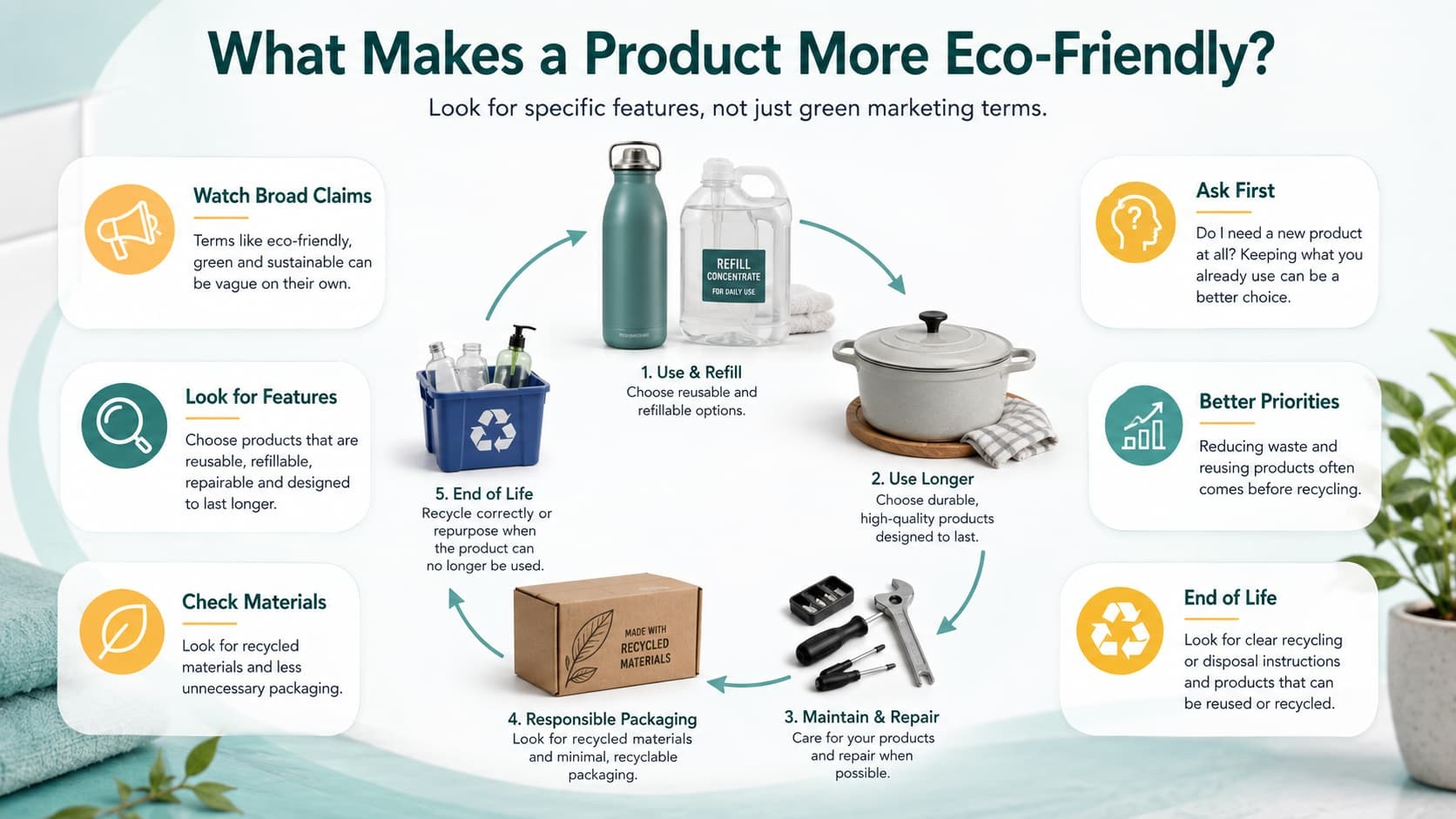
Instead of relying on one label, look for specific features.
A product may have features worth considering if it:
- can be reused many times
- can be refilled or repaired
- is designed to last longer
- contains recycled materials
- uses less unnecessary packaging
- has clear recycling or disposal instructions
- can be reused or recycled at the end of its useful life
- has environmental claims supported by clear information
The NSW Environment Protection Authority (EPA) places avoiding and reducing waste above recycling in its waste hierarchy. It also encourages choosing reusable, repairable and refillable goods where practical.
This means one of the simplest questions to ask before buying is: Do I need a new product at all?
Keeping something you already own in use can sometimes be a better choice than replacing it simply because a new item is marketed as “green”.
How to Compare Products Before You Buy
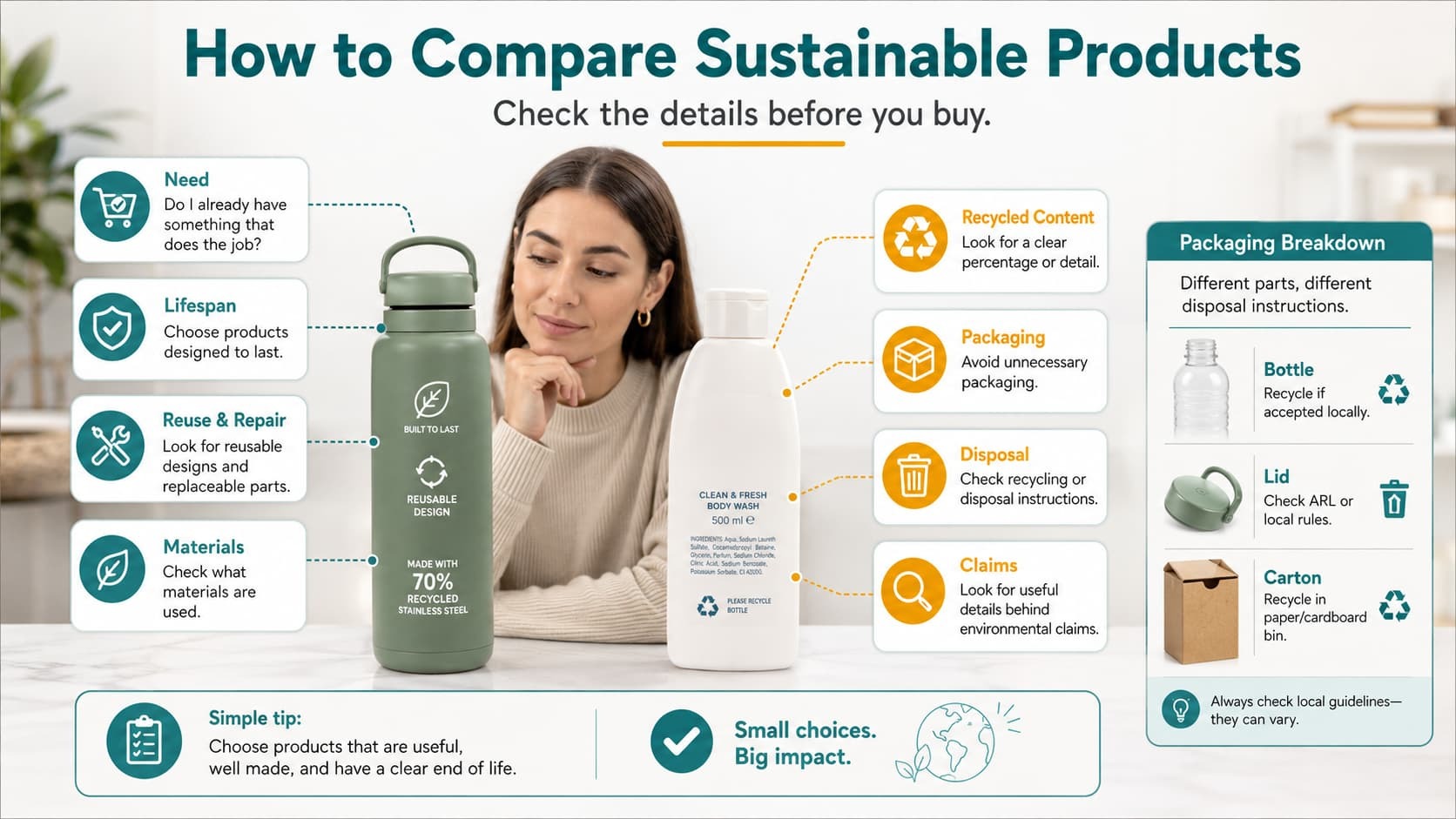
When comparing sustainable products or products promoted with environmental features, focus on details you can check.
Use this simple checklist:
The Australian Government's Department of Climate Change, Energy, the Environment and Water (DCCEEW) uses lifecycle and circular-economy thinking in its sustainable procurement guidance.
This means looking beyond the moment of purchase. How a product is made, used and eventually disposed of can all matter.
Check the packaging too
Packaging helps protect products and can be necessary for safety and transport. However, it can also create waste.
Look for clear disposal instructions rather than assuming all packaging with a recycling symbol can go into your household recycling bin.
DCCEEW says the Australasian Recycling Label (ARL) can show whether individual parts of packaging are recyclable, conditionally recyclable or not recyclable.
Follow the instructions on the packaging and your local council's recycling rules.
Natural, Vegan and Zero Waste: Know the Difference
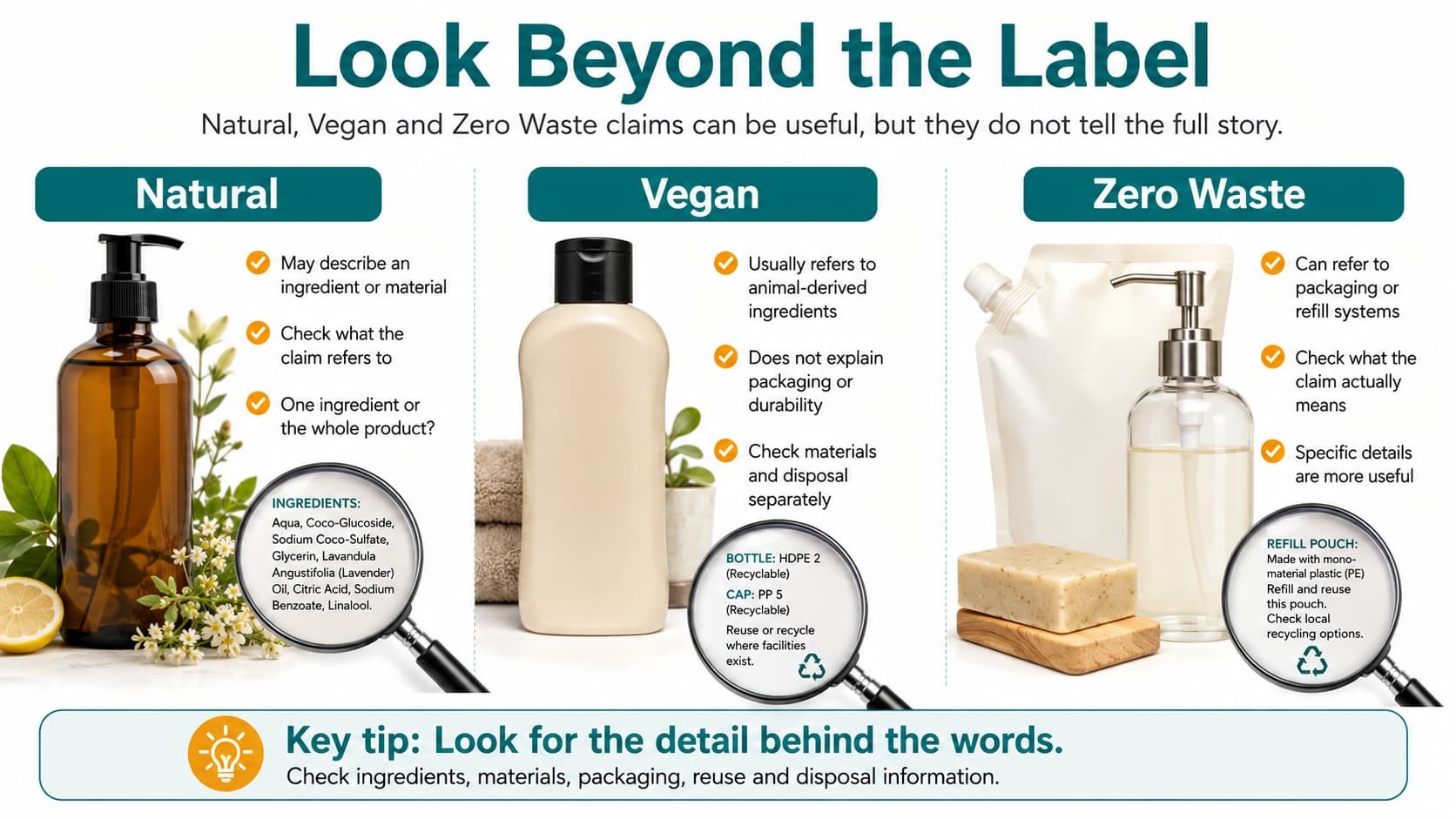
Words such as natural, vegan and zero waste may help describe certain product features. However, they do not automatically tell you the total environmental impact of a product.
Natural
“Natural” may refer to an ingredient or material.
Do not assume that natural automatically means better for the environment. Look for more detail about what the claim refers to.
For example, does it refer to one ingredient or the whole product?
Vegan
A vegan claim generally tells you something about the use of animal-derived ingredients or materials.
It does not automatically tell you whether the packaging is recyclable, whether the product is reusable, how long it lasts or how it was manufactured.
If environmental impact is important to you, check these details separately.
Zero waste
Zero waste is another broad term.
Check what the seller or manufacturer means. The claim might relate to packaging, production waste, a refill system or another part of the product lifecycle.
A clear statement is more useful than a broad label with no explanation.
The key lesson is simple: look for the detail behind the words.
Five Eco-Friendly Habits and Everyday Examples
What are five eco-friendly habits?
Shopping is only one part of reducing waste. Everyday habits can also make a difference.
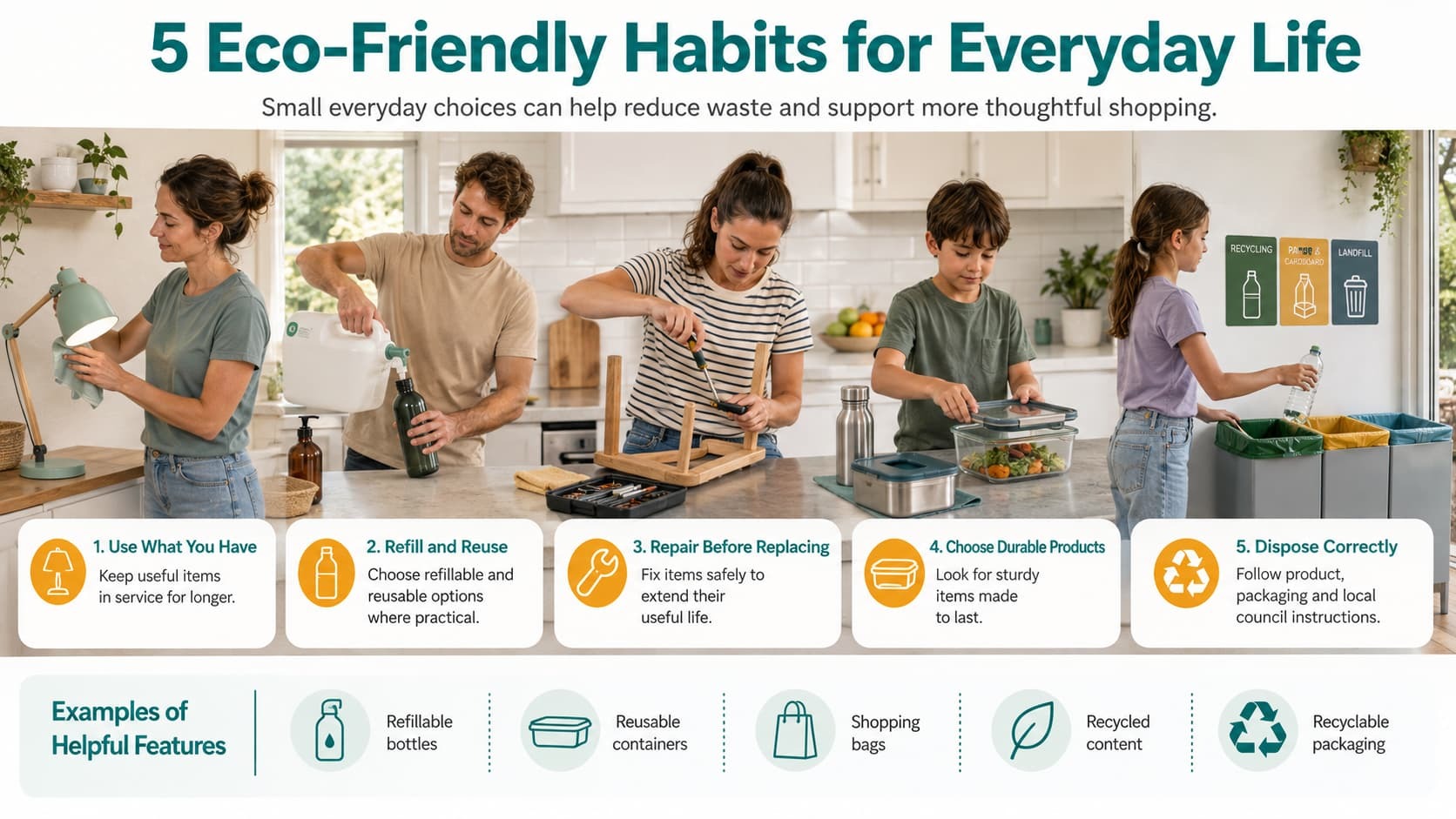
Here are five practical habits:
- Use what you already have. Avoid replacing useful items just to buy a newer option.
- Choose reusable items where practical. Reuse can help keep products and materials in use for longer.
- Repair before replacing. If an item can be repaired safely, this may extend its useful life.
- Choose durable products. Consider how long an item is likely to last instead of focusing only on its purchase price.
- Dispose of items correctly. Follow product, packaging and local council instructions.
These steps reflect the NSW EPA waste hierarchy, which gives priority to avoiding and reducing waste, followed by reuse and then recycling.
What are some eco-friendly items?
There is no universal list of products that are always environmentally better. However, shoppers may look for useful features such as:
- refillable drink bottles
- reusable food containers
- reusable shopping bags
- refillable personal-care containers
- reusable household cleaning items
- products containing clearly stated recycled content
- concentrated refill products
- durable items with replaceable parts
- products with reduced or clearly recyclable packaging
What are examples of eco-friendly choices?
An eco-friendly choice does not always involve buying something labelled “eco-friendly”.
Examples can include repairing a product, borrowing an item you rarely need, using a refill, choosing a reusable alternative or continuing to use something that still works.
The aim is to make a considered choice rather than buying based on a marketing label alone.
Marketing Pitfalls: How to Spot Greenwashing
What should you watch out for?
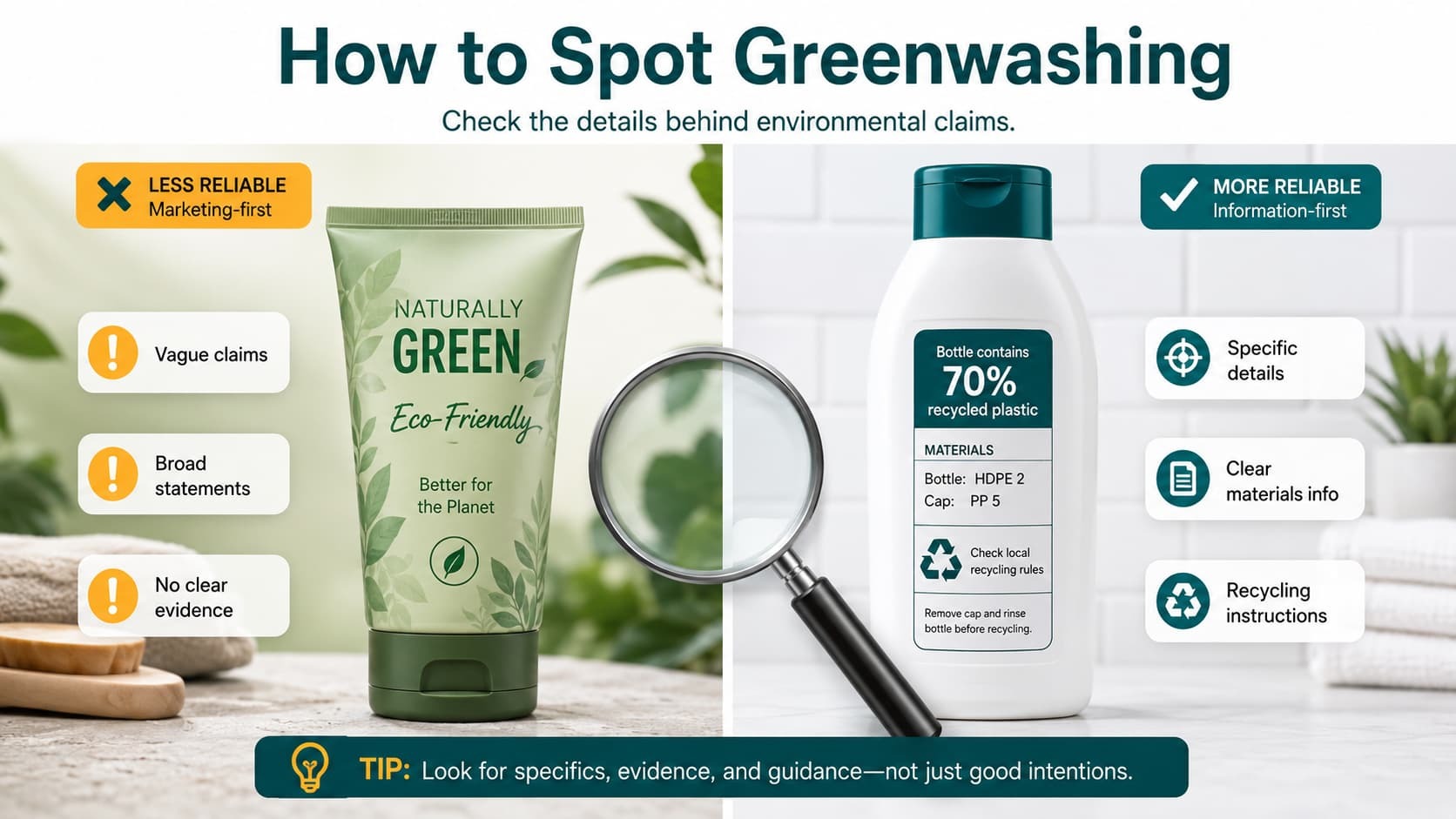
One of the biggest pitfalls is assuming a product is environmentally better because of how it looks or the words used on the package.
The ACCC describes greenwashing as environmental claims or missing information that can make a product, service or business appear better or less harmful to the environment than it really is.
The ACCC also says the overall impression matters. This can include wording, colours, pictures and logos.
Watch for these warning signs:
- Vague claims: Words such as “green”, “eco-friendly” or “sustainable” with little explanation.
- Very broad claims: One environmental feature is used to make the whole product sound environmentally better.
- Missing conditions: A recycling claim may leave out special instructions needed to recycle the item.
- Nature imagery: Green packaging, leaves or nature scenes are used without useful supporting information.
- No evidence: A claim is made without clear details explaining how it was measured or supported.
- Unclear comparisons: A product says it is “greener” or “better for the planet” without saying what it is being compared with.
Specific information is more useful.
For example, a claim such as “bottle contains 70% recycled plastic” gives you something clear to assess. A statement such as “good for the planet” provides far less information.
Treat environmental marketing as a reason to look closer, not as proof on its own.
FAQs
Is recyclable the same as eco-friendly?
No. Recyclability is only one feature to consider.
Also look at durability, reuse, repair, packaging and how the product is likely to be used.
Is natural always better for the environment?
Not necessarily.
“Natural” may describe an ingredient or material, but it does not explain the whole lifecycle of the product. Check what the claim refers to and look for specific supporting details.
Does vegan mean sustainable?
Not automatically.
A vegan claim and an environmental claim describe different things. If sustainability matters to you, also consider packaging, materials, durability, reuse and disposal.
Is reusable always better?
Reuse can help keep materials in use for longer, but how often an item is used matters.
Choose reusable products you are likely to keep and use rather than buying unnecessary reusable items.
Summary
Finding products that suit your sustainability goals is less about spotting the right buzzword and more about checking the details behind the claim.
Ask whether you need something new first. If you do, consider its expected lifespan, materials, packaging, reuse options and disposal instructions.
Words such as eco-friendly, natural, vegan, zero waste and sustainable may provide useful clues, but they should not replace clear product information.
A simple rule can help: buy thoughtfully, use products for longer and check the evidence behind environmental claims.
Where to Buy
Looking for products that may support more sustainable everyday choices?
Explore the Eco-Friendly Products search on MedCart Australia and compare individual listings to find options that suit your needs.
Product features and environmental claims can vary between products. Environmental information shown in individual listings may be supplied by the seller or manufacturer. Check the product description, materials, packaging and supporting information before making your choice.
Explore: Eco-Friendly Products on MedCart Australia
You can also visit MedCart Australia at medcart.com.au.
References
- Australian Competition and Consumer Commission (ACCC). Environmental and Sustainability Claims. Current consumer guidance, accessed 3 September 2026. URL: https://www.accc.gov.au/consumers/advertising-and-promotions/environmental-and-sustainability-claims
- Australian Competition and Consumer Commission (ACCC). A Guide to Making Environmental Claims for Business. Published 12 December 2023. Guidance updated online to note Australian Consumer Law penalty changes effective 28 March 2026. URL: https://www.accc.gov.au/about-us/publications/a-guide-to-making-environmental-claims-for-business
- Department of Climate Change, Energy, the Environment and Water (DCCEEW). Sustainable Procurement Guide. Last updated 12 June 2024. URL: https://www.dcceew.gov.au/environment/protection/waste/sustainable-procurement/sustainable-procurement-guide
- Department of Climate Change, Energy, the Environment and Water (DCCEEW). Environmentally Sustainable Procurement Policy. Last updated 22 October 2025. URL: https://www.dcceew.gov.au/environment/protection/waste/sustainable-procurement/environmentally-sustainable-procurement-policy
- Department of Climate Change, Energy, the Environment and Water (DCCEEW). Recycling Packaging – Australasian Recycling Label. Last updated 2 October 2025. URL: https://www.dcceew.gov.au/environment/protection/waste/packaging/australasian-recycling-label
- Department of Climate Change, Energy, the Environment and Water (DCCEEW). A Circular Economy for Packaging in Australia. Last updated 3 February 2026. URL: https://www.dcceew.gov.au/environment/protection/waste/packaging
- NSW Environment Protection Authority (EPA). The Waste Hierarchy. Updated 20 October 2022. URL: https://www.epa.nsw.gov.au/Your-environment/Recycling-and-reuse/warr-strategy/The-waste-hierarchy
- NSW Environment Protection Authority (EPA). Circular Economy. Current NSW EPA guidance, accessed 3 September 2026. URL: https://www.epa.nsw.gov.au/Working-together/For-local-government/Circular-economy