A vapouriser, humidifier, dehumidifier and diffuser can look similar. Some also make a visible mist.
However, they do different jobs.
The easiest way to remember the difference is:
- Vapouriser = STEAM
- Humidifier = ADDS MOISTURE
- Dehumidifier = REMOVES MOISTURE
- Diffuser = ADDS SCENT
This guide will help you choose the right product. It also explains how to check what a product really does before you buy it.
The Main Difference
Do Not Trust the Product Name Alone
Some product names can be confusing.
A small aroma diffuser may also be called a “humidifier” because it releases water mist. However, it may not add enough moisture to change the humidity of a whole room.
A waterless scent device may also be called a “vapouriser”. However, it does not use water or create steam.
Before buying, check:
- What goes inside the device
- Whether it uses heat
- How much mist it makes
- What room size it covers
- Whether it measures humidity
- Whether its main feature is moisture or fragrance
How to Tell What the Product Really Is
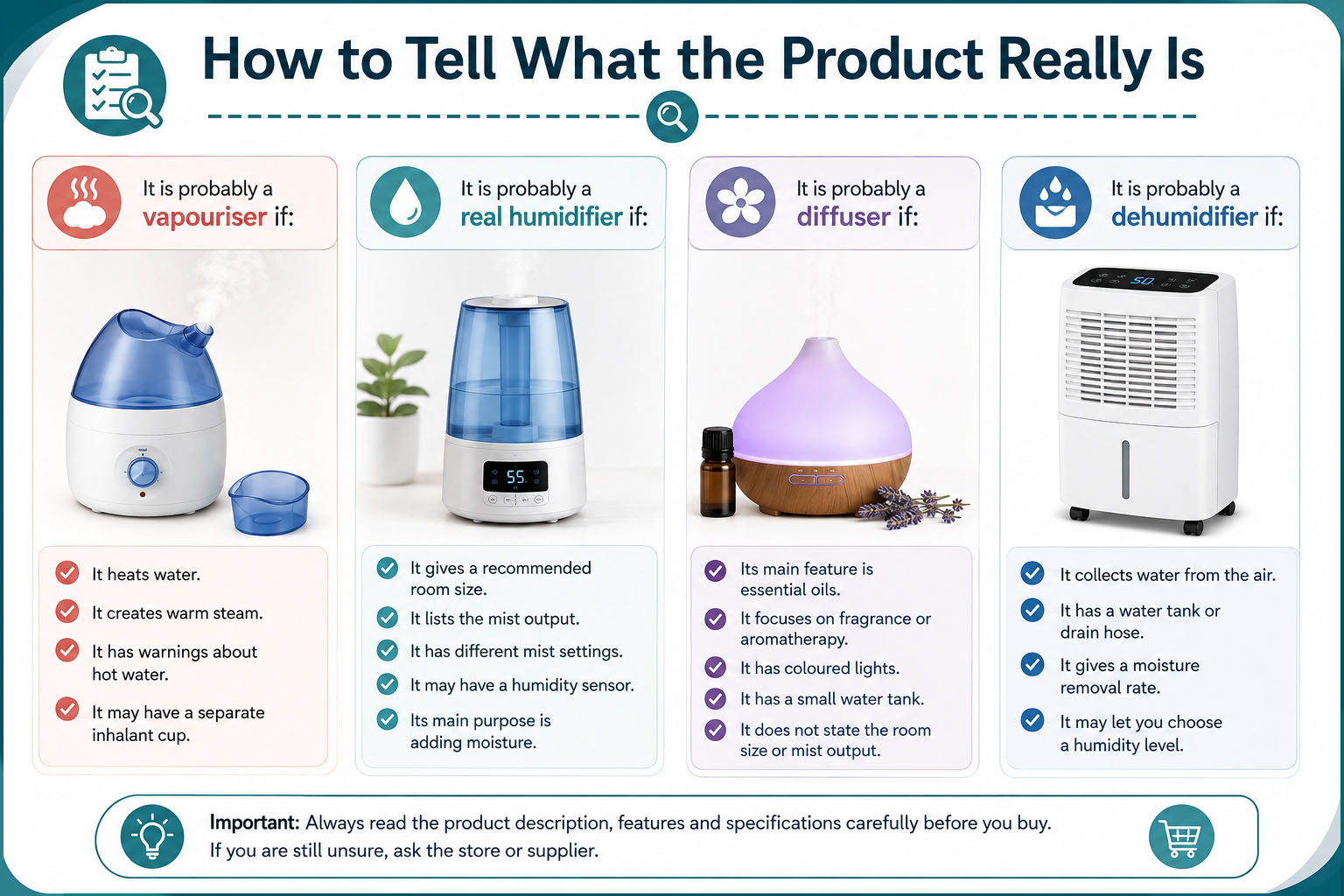
It is probably a vapouriser if:
- It heats water.
- It creates warm steam.
- It has warnings about hot water.
- It may have a separate inhalant cup.
It is probably a real humidifier if:
- It gives a recommended room size.
- It lists the mist output.
- It has different mist settings.
- It may have a humidity sensor.
- Its main purpose is adding moisture.
It is probably a diffuser if:
- Its main feature is essential oils.
- It focuses on fragrance or aromatherapy.
- It has coloured lights.
- It has a small water tank.
- It does not state the room size or mist output.
It is probably a dehumidifier if:
- It collects water from the air.
- It has a water tank or drain hose.
- It gives a moisture removal rate.
- It may let you choose a humidity level.
Is It Really a Humidifier?
Some small diffusers include the word “humidifier” in the product title.
Use this simple check:
A water tank alone does not make a product a good room humidifier.
What Is a Vapouriser?
A traditional vapouriser heats water to make warm steam. The steam also adds moisture to the air.
The main difference is heat.
When to use a vapouriser
A vapouriser may suit you if:
- You prefer warm steam.
- You have a safe place for the device.
- Children cannot reach it.
- You want to use an approved vapouriser inhalant.
MedCart example
The Vicks Warm Steam Vaporizer is clearly a warm-steam product.
It heats water and adds moisture to the air.
Because it uses hot water, it should be placed on a flat and stable surface. Keep it away from children.
What can you use with it?
Some warm-steam models have a cup for an approved inhalant.
For example, Vicks VapoSteam Inhalant 100 mL is made for compatible vapourisers.
Always check the instructions. Do not pour oils or inhalants into the water unless the manufacturer allows it.
Not Every Vapouriser Makes Steam
Some products called vapourisers do not use water.
The Vicks Portable Waterless Vaporizer heats a fragrance pad. It releases scent but does not add much moisture.
This means it is not a room humidifier.
Simple difference:
- Warm-steam vapouriser = water and steam
- Waterless vapouriser = fragrance vapour
What Is a Humidifier?
A humidifier adds moisture to dry indoor air.
It may produce:
- Cool mist
- Warm mist
- Moisture through evaporation
The main difference is moisture control.
When to use a humidifier
A humidifier may suit you if:
- A room feels very dry.
- Heating dries the air.
- Air conditioning dries the air.
- A humidity meter shows a low reading.
- You want cool mist instead of hot steam.
MedCart example
The Vicks Mini Cool Mist Humidifier 1.8 L is designed to add cool moisture to the air.
It may suit a bedroom, office or other small room.
Before buying, check:
- Room coverage
- Mist output
- Runtime
- Cleaning instructions
- Recommended water type
What Is a Diffuser?
A diffuser spreads fragrance or essential oils around a room.
It may use water and make mist. However, its main job is adding scent.
When to use a diffuser
A diffuser may suit you if:
- You want a pleasant room fragrance.
- You want to use a compatible essential oil.
- You like coloured light or timer features.
- You do not need strong humidity control.
MedCart example
The Devanti 400 mL Aroma Diffuser Ultrasonic Air Humidifier includes both “diffuser” and “humidifier” in its name.
However, its main features focus on:
- Essential oils
- Fragrance
- Timer settings
- Quiet use
- Decorative design
It creates some water mist. However, it is better treated as a small aroma diffuser unless the product details confirm room coverage and humidity output.
It may suit a desk, bedside table or small personal area.
Humidifier vs Diffuser
This is the most common product mix-up.
Simple difference: A humidifier changes moisture. A diffuser changes scent.
What Is a Dehumidifier?
A dehumidifier removes extra moisture from the air.
It collects the water in a tank or sends it through a drain hose.
The main difference is moisture removal.
When to use a dehumidifier
A dehumidifier may suit you if:
- Windows often have condensation.
- The room feels damp.
- There is a musty smell.
- Indoor washing dries slowly.
- A humidity meter shows a high reading.
A dehumidifier cannot repair a leaking pipe, wall or roof. The source of the water must also be fixed.
MedCart example
The Devanti 2 L Dehumidifier is a powered dehumidifier with a water tank and drainage options.
It may suit a damp bedroom, laundry or other small room.
Before buying, check:
- Litres removed each day
- Recommended room size
- Tank size
- Drain hose option
- Noise level
- Power use
The tank size and removal rate are not the same.
A 2 L tank tells you how much water the tank can hold. It does not tell you how quickly the machine removes moisture.
Powered Dehumidifier vs Moisture Absorber
A moisture absorber may also be called a dehumidifier. However, it is less powerful than an electric unit.
The Pingi Reusable Dehumidifier 150 g is a small reusable moisture absorber.
It may suit:
- A cupboard
- A wardrobe
- A car
- A storage box
- A small enclosed area
It is not made to control moisture across a damp bedroom.
Which Product Suits Your Needs?
Are There Any Health Benefits?
These products mainly change the room environment. They do not replace medical care.
Humidifier
Healthdirect Australia suggests humidifiers in some guidance for discomfort linked with dry air. This includes dry eyes, dry mouth, itchy skin and some nosebleeds.
A humidifier may help make dry air feel more comfortable. However, too much humidity may support dampness and mould.
Vapouriser
Warm steam may feel comforting. However, there is not enough evidence that steam treats the common cold.
The Royal Children’s Hospital Melbourne says steam and vapourisers do not help croup.
Dehumidifier
A dehumidifier can reduce damp air. This may make it harder for mould to grow.
However, it does not remove existing mould or treat asthma and allergies.
Diffuser
A diffuser can add a pleasant fragrance.
Research into the health benefits of aromatherapy is still limited. A diffuser should not be treated as a cure for stress, poor sleep, pain or illness.
Essential oils can also cause irritation. They can be poisonous if swallowed.
What Makes a Good-Quality Product?
Good vapouriser
Look for:
- A stable base
- Automatic shut-off
- Clear hot-water warnings
- Easy cleaning
- A separate approved inhalant cup
- Clear instructions and warranty
Good humidifier
Look for:
- Room coverage
- Mist output
- Adjustable mist
- Automatic shut-off
- Easy-to-clean tank
- Humidity sensor
- Available replacement filters
Good dehumidifier
Look for:
- Daily moisture removal rate
- Room coverage
- Humidity control
- Full-tank shut-off
- Drain hose option
- Clear noise and power information
- Warranty
Good diffuser
Look for:
- Waterless shut-off
- Clear oil instructions
- Easy cleaning
- Timer settings
- Adjustable mist
- Stable base
- Warranty
Things to Know Before Buying
1. Choose your main goal.
Do you want steam, more moisture, less moisture or scent?
2. Check the room humidity.
Do not guess if the room is dry or damp.
3. Check the room size.
A small desk product may not work across a bedroom.
4. Read the specifications.
Look for output, coverage and controls.
5. Check cleaning needs.
Water tanks need regular cleaning.
6. Check extra costs.
You may need filters, pads, oils or inhalants.
7. Check safety features.
Look for automatic shut-off and a stable base.
8. Do not rely on the product name.
Check what the device actually does.
Where to Buy
You can compare vapourisers, humidifiers, dehumidifiers and diffusers from Australian marketplace sellers at MedCart Australia.
Explore:
- Shop vapourisers
- Shop humidifiers
- Shop dehumidifiers
- Shop diffusers
- Shop vapouriser inhalants
- Shop essential oils
Visit MedCart Australia to compare available products and sellers.
Final Summary
Remember these four simple differences:
- Vapouriser = STEAM
- Humidifier = ADDS MOISTURE
- Dehumidifier = REMOVES MOISTURE
- Diffuser = ADDS SCENT
Do not choose a product by its name alone. Check its room coverage, output, controls and main purpose before buying.
This article provides general information only. It is not medical advice.
References
- United States Environmental Protection Agency. Care for Your Air: A Guide to Indoor Air Quality. Updated September 2025.
- United States Environmental Protection Agency. Use and Care of Home Humidifiers. Updated April 2026.
- United States Centers for Disease Control and Prevention. Preventing Waterborne Germs at Home: Portable Humidifiers. Accessed August 2026.
- Healthdirect Australia. Dry Eye Disease. Accessed August 2026.
- Healthdirect Australia. Dry Mouth Syndrome. Reviewed 2025.
- Healthdirect Australia. Itchy Skin. Reviewed 2025.
- Healthdirect Australia. Nosebleeds. Reviewed 2026.
- The Royal Children’s Hospital Melbourne. Kids Health Info: Croup. Reviewed June 2026.
- South Eastern Sydney Local Health District, NSW Health. Mould. Accessed August 2026.
- NSW Poisons Information Centre. Poisons in the Home. Accessed August 2026.
- Cochrane. Heated, Humidified Air for the Common Cold.
- National Center for Complementary and Integrative Health. Aromatherapy. Accessed August 2026.