Introduction
The healthiest makeup is not simply the product labelled “natural”, “clean” or “chemical-free”.
A better choice is makeup that:
- comes from a reliable source
- has a clear ingredient list
- suits your skin type
- avoids ingredients you already react to
- is used and removed properly.
Some ingredients commonly used in foundation, lipstick, mascara and other makeup can cause allergies or irritation in certain people. People with eczema, dermatitis, acne or rosacea may need to be especially careful because their skin can already be sensitive or inflamed.
You do not need to memorise hundreds of ingredients.
Instead, remember one word: CHECK.
C — Check the Label, Formula and Product Source
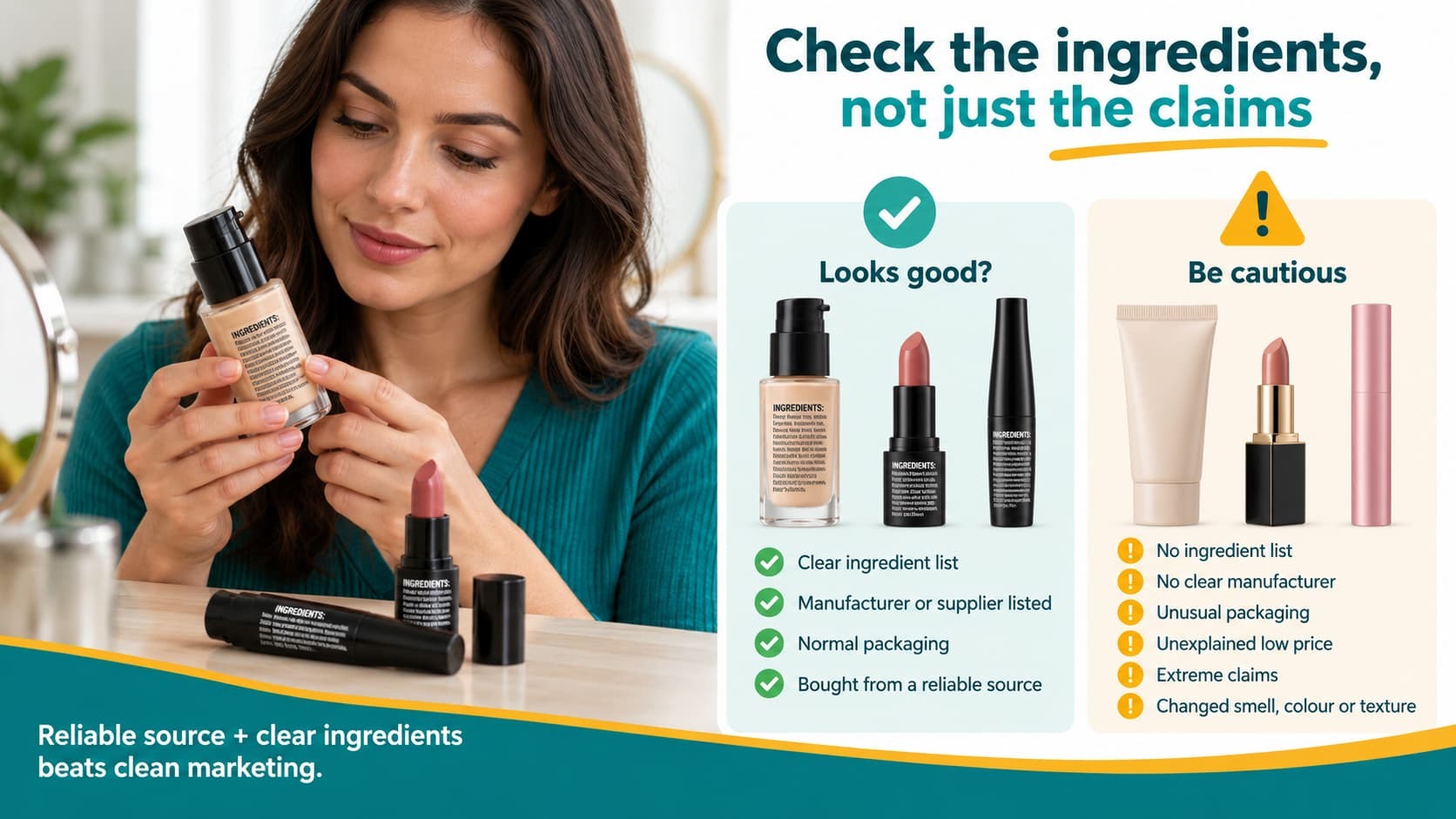
Start with the back of the package, not the claims on the front.
In Australia, cosmetic ingredient information must generally be available so consumers can identify ingredients they may need to avoid.
Be cautious if a makeup product has:
- no ingredient list
- no clear manufacturer or supplier
- unusual or counterfeit-looking packaging
- an unexplained very low price
- extreme claims such as “completely toxin-free”
- a changed smell, colour or texture.
What about banned ingredients?
Australia prohibits or tightly restricts certain substances for cosmetic use.
Examples include some phthalates such as dibutyl phthalate (DBP), DEHP and diisobutyl phthalate, as well as certain other chemicals listed in the Australian Poisons Standard.
These are not normal ingredients you should expect to find in properly supplied everyday foundation, blush, lipstick or mascara.
For most shoppers, checking that a product comes from a reliable source is more practical than trying to memorise every prohibited chemical.
Do not fear every chemical-sounding ingredient
A long name does not automatically mean an ingredient is harmful.
For example, preservatives have an important job. Water-based foundation, liquid concealer and mascara need protection against bacteria, yeast and mould.
Likewise, silicones such as dimethicone are commonly used to help makeup spread smoothly and are not automatically bad for the skin.
Remember: Reliable source + clear ingredients beats “clean” marketing.
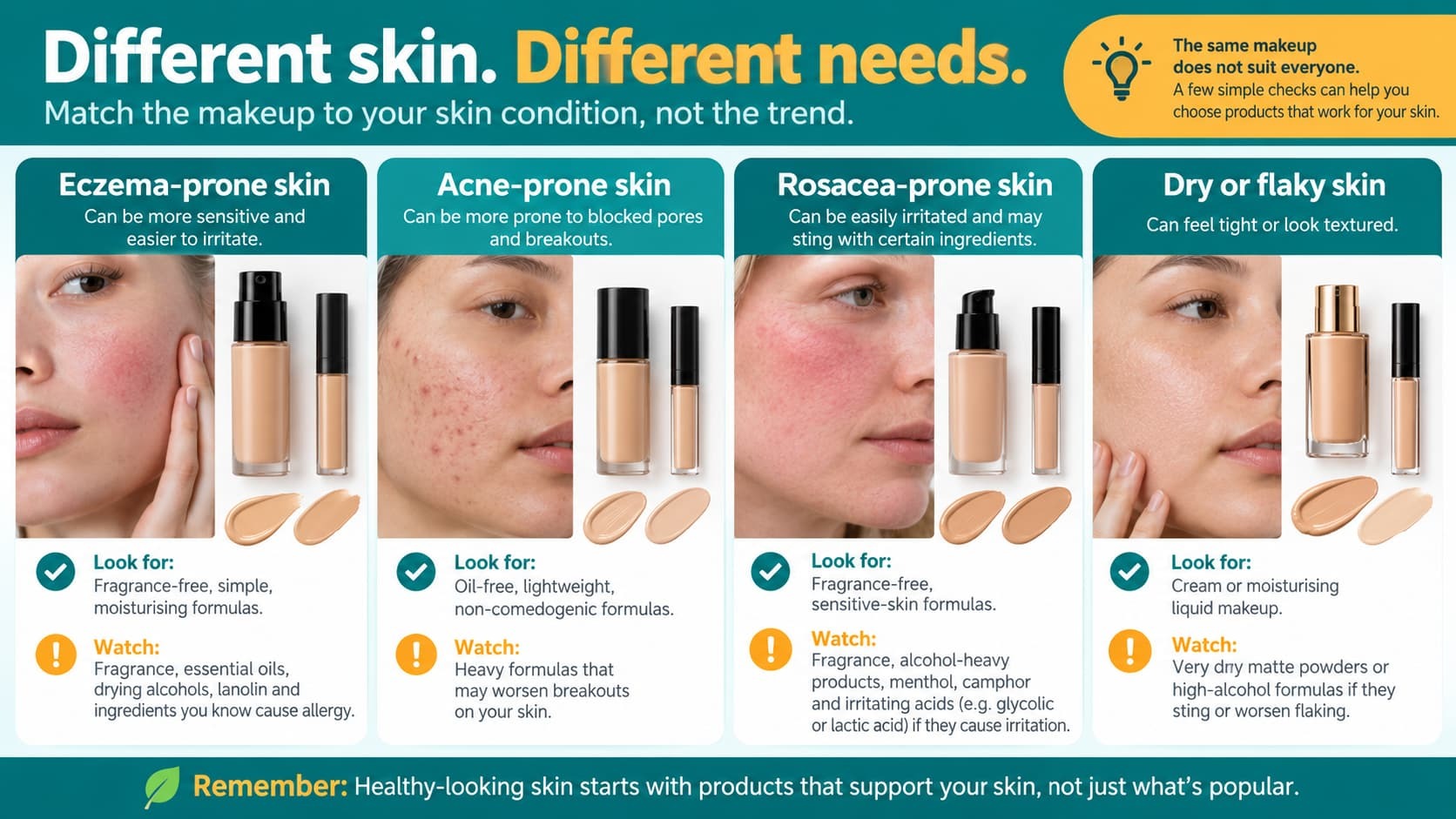
H — Have a Skin Condition? Match the Makeup to Your Skin
The same makeup does not suit every skin condition.
A useful shortcut is:
Makeup and eczema
Eczema-prone skin has a weaker skin barrier, which can make it easier for products to sting or irritate.
The Eczema Association of Australasia recommends fragrance-free rather than merely unscented products for eczema-prone skin.
Other ingredients worth watching include:
Fragrance or parfum Fragrance is a common cosmetic irritant and allergen.
Essential oils Lavender, peppermint, citrus and other essential oils may sound gentle because they are natural, but they can contain fragrance allergens.
Drying alcohols Ingredients such as alcohol denat., ethanol or isopropyl alcohol can feel drying or sting some eczema-prone skin. These are different from fatty alcohols such as cetyl alcohol and stearyl alcohol, which are often used as moisturising ingredients.
Lanolin Lanolin is found in some foundations, concealers, eye makeup and lip products. Most people tolerate it, but DermNet notes that people with already damaged or atopic skin appear more likely to become sensitised.
If eczema is cracked, weeping or actively inflamed, taking a break from makeup may be more comfortable until the flare settles.
Makeup and acne
For acne-prone skin, Australian health guidance recommends looking for oil-free and non-comedogenic cosmetics.
Do not become too focused on online lists of supposedly “pore-clogging” ingredients. How the complete formula behaves on your skin matters more.
Makeup and rosacea
Rosacea-prone skin often stings easily.
The American Academy of Dermatology advises people with rosacea to watch for ingredients such as fragrance, alcohol, menthol, camphor, glycolic acid and lactic acid if these cause irritation.
Remember: Match the makeup to the condition, not the trend.
E — Examine Common Makeup Allergens
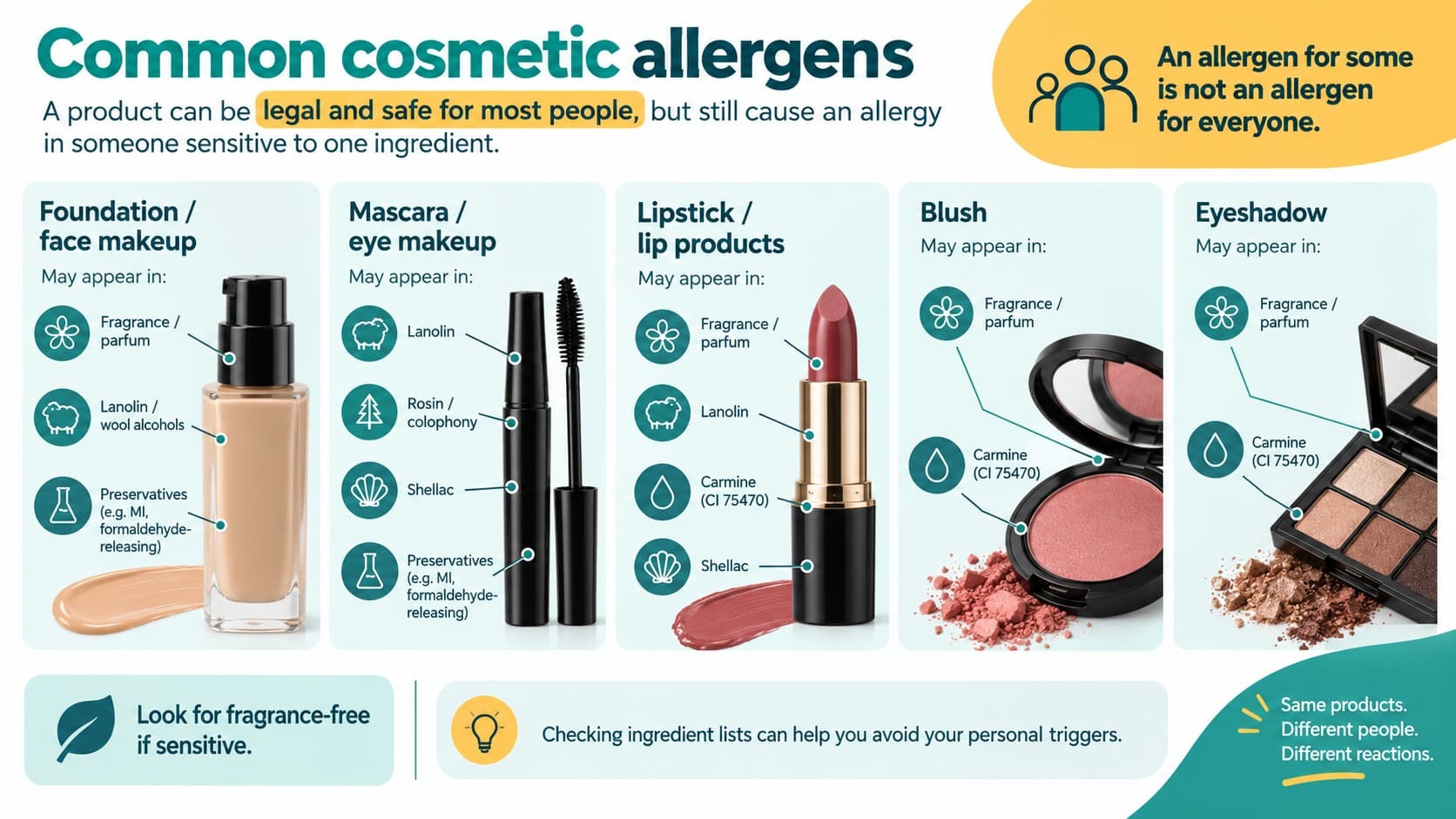
A product can be legal and safe for most people but still cause an allergy in someone who is sensitive to one ingredient.
DermNet says fragrance and preservatives are among the most common causes of cosmetic contact allergy.
For makeup specifically, remember these common label names:
Fragrance / parfum
May be found in foundation, primer, lipstick and other face products.
If you have fragrance allergy or eczema-prone skin, look for fragrance-free, not just “unscented”.
Lanolin / wool alcohols
May appear in:
- foundation
- concealer
- powder
- eye makeup
- glossy lipstick.
Avoid it if you have a known lanolin allergy.
Carmine / CI 75470
Carmine creates red and pink shades in some:
- lipsticks
- blushes
- eyeshadows.
It can rarely cause allergic reactions. Carmine also comes from cochineal insects, so it is not vegan.
Rosin / colophony and shellac
These resins can appear in mascara, eye products and some lip cosmetics and can cause contact allergy in susceptible people.
Preservatives
Preservatives are important in liquid makeup, but particular preservatives can cause allergy.
Examples recognised in cosmetic allergy include methylisothiazolinone (MI) and certain formaldehyde-releasing preservatives.
You do not need to avoid all preservatives. If you have repeated reactions, a dermatologist can use patch testing to help identify your actual allergy.
Remember: An ingredient being an allergen does not mean everyone is allergic to it.
C — Consider Cruelty-Free, Vegan and Natural Claims
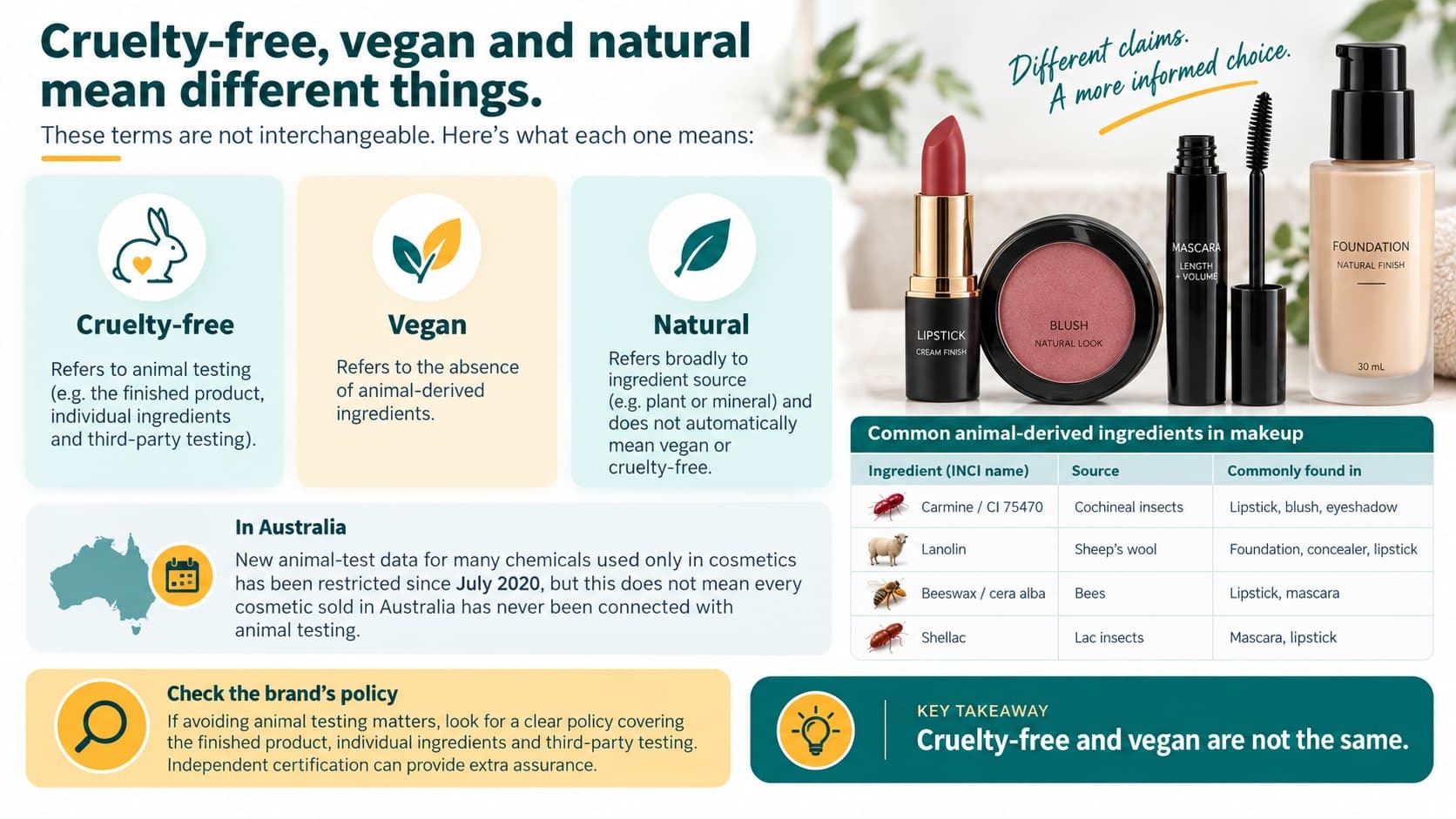
These three words mean different things.
Cruelty-free refers to animal testing.
Vegan refers to animal-derived ingredients.
Natural refers broadly to ingredient source and does not automatically mean either vegan or cruelty-free.
Australia has restricted the use of new animal-test data for many chemicals used only in cosmetics since July 2020. However, this does not mean every cosmetic sold in Australia has never been connected with animal testing.
If avoiding animal testing matters to you, look for a clear policy covering:
- the finished product
- individual ingredients
- third-party testing.
Independent certification can provide extra assurance.
Animal-derived ingredients commonly found in makeup
A product can therefore be cruelty-free but not vegan.
It can also be vegan without necessarily meeting a cruelty-free certification standard.
K — Keep Your Skin and Makeup Clean
Even the right formula can cause problems if makeup is applied to irritated skin or contaminated tools.
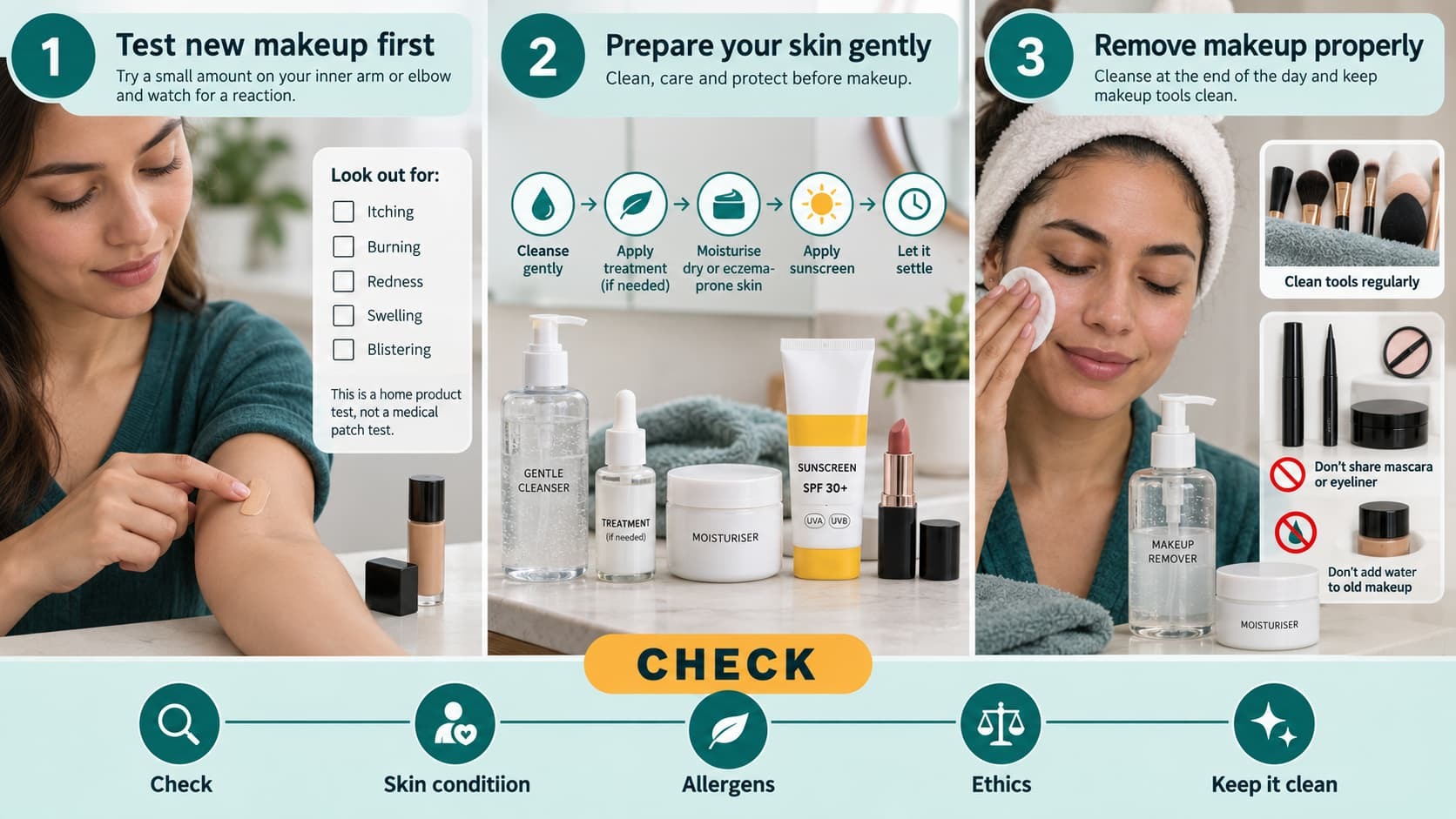
Test new makeup first
If you have sensitive or eczema-prone skin, introduce one new product at a time.
Apply a small amount to an area such as the inner arm or elbow and watch for:
- itching
- burning
- redness
- swelling
- blistering.
A home product test is not the same as medical patch testing.
Healthdirect says doctors can use patch testing when allergic contact dermatitis is suspected.
Before makeup
Keep preparation gentle:
- Wash your hands.
- Cleanse gently if needed.
- Apply prescribed skin treatments as directed.
- Moisturise dry or eczema-prone skin.
- Apply appropriate sunscreen.
- Allow skincare to settle before applying makeup.
Avoid scrubbing flaky eczema before covering it with foundation.
After makeup
Remove makeup before bed without aggressive rubbing.
For eczema-prone skin, Eczema Association Australasia recommends gentle removal followed by moisturiser.
Also:
- wash brushes and sponges regularly
- do not share mascara or eyeliner
- keep containers closed
- do not add water to old makeup
- replace products that change smell, colour or texture.
If makeup causes repeated burning, itching or a rash, stop using it.
If reactions keep happening with different products, speak with your GP or dermatologist.
The CHECK rule: Check. Have a skin condition? Examine allergens. Consider ethics. Keep it clean.
FAQs
What is the best makeup for eczema?
There is no single best product. A good starting point is fragrance-free makeup made for sensitive skin, with a comfortable cream or liquid texture if your skin is dry.
Avoid makeup over badly cracked, weeping or infected eczema.
Should eczema-prone skin avoid alcohol?
Not every alcohol is the same.
Alcohol denat., ethanol and isopropyl alcohol can feel drying or sting sensitive skin. Fatty alcohols such as cetyl and stearyl alcohol are different and are commonly used to help moisturise or thicken products.
Can makeup cause eczema?
Makeup does not necessarily cause atopic eczema, but an ingredient can trigger irritant or allergic contact dermatitis, which may look like or worsen eczema.
What is the first ingredient I should check if my skin is very sensitive?
Fragrance is a useful first check because it is one of the most common causes of cosmetic contact allergy.
Summary: Remember CHECK
When choosing skin-friendly cosmetics, remember:
C — Check the label and source. Choose clearly labelled cosmetics from a reliable supplier.
H — Have a skin condition? Match the formula to eczema, acne, rosacea or dry skin.
E — Examine allergens. Fragrance, preservatives, lanolin, carmine and other ingredients can cause reactions in some people.
C — Consider cruelty-free and vegan claims. They mean different things.
K — Keep everything clean. Test new products, prepare your skin gently and remove makeup every night.
Where to Buy
When shopping for makeup, look beyond the front of the package. Compare the ingredients, formula, skin suitability and ethical claims.
You can explore skincare, personal care and beauty products at MedCart Australia: https://medcart.com.au
If you have ongoing eczema, dermatitis, rosacea, acne or repeated cosmetic reactions, speak with a doctor, pharmacist or dermatologist for individual advice.
References
- Australian Industrial Chemicals Introduction Scheme (AICIS). Personal care, skincare, make-up and other cosmetic products. Last updated 7 February 2025. https://www.industrialchemicals.gov.au/cosmetics-and-soap/personal-care-skincare-make-and-other-cosmetic-products
- Australian Industrial Chemicals Introduction Scheme (AICIS). Banned or restricted chemicals. Last updated 1 October 2024. https://www.industrialchemicals.gov.au/chemical-information/banned-or-restricted-chemicals
- Federal Register of Legislation. Therapeutic Goods (Poisons Standard—June 2026) Instrument 2026. Effective 1 June 2026. https://www.legislation.gov.au/F2026L00633/latest/text
- Australian Competition and Consumer Commission – Product Safety Australia. Cosmetic ingredients labelling guide. Publication date not stated. https://www.productsafety.gov.au/consumers/use-cosmetic-and-fashion-products-safely/cosmetic-ingredients-labelling-guide
- DermNet. Contact reactions to cosmetics. Reviewed February 2023. https://dermnetnz.org/topics/contact-reactions-to-cosmetics
- DermNet. Contact reactions to lanolin. Reviewed March 2023. https://dermnetnz.org/topics/contact-reactions-to-lanolin
- Eczema Association Australasia. Eczema Skincare Routine: A Guide for Every Age. Published August 2026. https://eczema.org.au/eczema-skincare-routine/
- Eczema Association Australasia. How to Choose Skincare Products for Eczema. Published 2025. https://eczema.org.au/choose-skincare-products-for-eczema/
- American Academy of Dermatology. 7 rosacea skin care tips dermatologists recommend. Current guidance accessed September 2026. https://www.aad.org/public/diseases/rosacea/triggers/tips
- Healthdirect Australia. Contact dermatitis – treatments, symptoms and prevention. Current guidance accessed September 2026. https://www.healthdirect.gov.au/contact-dermatitis
- Australian Industrial Chemicals Introduction Scheme (AICIS). Use of animal test data. Last updated 24 August 2026. https://www.industrialchemicals.gov.au/business/use-animal-test-data
- RSPCA Australia Knowledgebase. Is cosmetic testing on animals legal in Australia? Updated 27 July 2021. https://kb.rspca.org.au/categories/animals-in-research-and-teaching/is-cosmetic-testing-on-animals-legal-in-australia