Alcohol Wipes Explained: Types, Uses and How to Choose
Alcohol wipes are useful for quick and simple cleaning. However, not every alcohol wipe is made for the same job.
Some are made for skin. Others are made for benches, tools or medical equipment. They also come in different strengths, sizes and materials.
The easiest way to choose is to ask:
What do I need to wipe: skin, hands, equipment or a hard surface?
Always choose the wipe by its intended use. Do not choose it only because it has a high alcohol percentage.
Quick guide: Which alcohol wipe do I need?
The label should clearly say where the wipe can be used.
What are alcohol wipes?
Alcohol wipes are small pieces of material soaked in an alcohol solution.
The two main types of alcohol used are:
- Isopropyl alcohol, also called IPA
- Ethyl alcohol, also called ethanol
Alcohol wipes may help reduce some microbes when used correctly. However, their purpose depends on the label.
A skin wipe and a surface wipe may both contain 70% alcohol. This does not mean they can be used in the same way.
According to the Therapeutic Goods Administration, or TGA, hard-surface disinfectants are made for surfaces. They are not automatically safe for skin.
Main types of alcohol wipes
1. Skin prep alcohol wipes
Skin prep wipes are made for small areas of intact skin. They are often called:
- Alcohol prep pads
- Alcohol swabs
- Antiseptic wipes
- Pre-injection wipes
They are usually small, soft and individually wrapped. Some are also sterile.
They may be used before certain injections or minor medical procedures. Follow the product directions and advice from your healthcare professional.
The Australian Immunisation Handbook says visibly clean skin does not normally need an alcohol wipe before vaccination. If an alcohol wipe is required, the skin should dry fully before the injection.
2. Surface alcohol wipes
Surface alcohol wipes are made for hard surfaces such as:
- Benches
- Trolleys
- Door handles
- Desks
- Some medical equipment
- Some stainless-steel surfaces
These wipes are usually larger than skin prep pads. They often come in a tub or canister.
A surface alcohol wipe should not be used on skin unless the label clearly says it is safe.
3. Hand alcohol wipes
Some alcohol wipes are made for hands. The pack should clearly say “hand wipe” or “for hand hygiene.”
Do not use a surface wipe on your hands.
The Australian Commission on Safety and Quality in Health Care recommends soap and water when hands are visibly dirty.
4. Equipment alcohol wipes
These wipes are made for suitable tools or equipment.
Before using one, check:
- The wipe label
- The equipment maker’s cleaning guide
- The required wet contact time
- Whether alcohol may damage the material
Alcohol can damage some plastics, screens, paints, rubber parts and protective coatings.
Understanding alcohol strength
The alcohol percentage tells you how much alcohol is in the liquid. It does not tell you the full purpose of the wipe.
60% to 80% alcohol
The Australian Commission on Safety and Quality in Health Care states that alcohol solutions between 60% and 80% are the most effective range for alcohol-based hand rub.
This does not mean every wipe in this range is suitable for hands. Always read the label.
70% alcohol wipes
Seventy per cent isopropyl alcohol is common in both skin and surface wipes.
You may find 70% alcohol in:
- Small skin prep pads
- Pre-injection swabs
- Equipment wipes
- Large hard-surface wipes
These products may have the same alcohol strength but different uses.
75% alcohol wipes
Some wipes contain 75% ethyl alcohol. These may be sold for skin, hands or cleaning.
Check the intended use before buying.
Alcohol wipes above 90%
High-strength alcohol wipes may be made for special cleaning tasks.
A higher number does not always mean better cleaning or disinfection. High-strength alcohol can evaporate quickly. It may also damage certain materials.
Only use these wipes when the label and the item maker allow it.
Choosing the right wipe size
The size of the wipe should match the area you need to clean.
A small alcohol swab may dry before it covers a large bench. A large wipe may be wasteful for one small skin area.
Individually wrapped wipes
These are useful for:
- First aid kits
- Travel
- Home care
- Clinics
- Small skin preparation tasks
Each wipe stays sealed until it is needed.
Wipes in a tub
Tubs are useful when you need to clean surfaces often. Always close the lid after taking out a wipe.
Alcohol can evaporate when the lid is left open.
Choosing the right wipe material
Most alcohol wipes use non-woven material. This means the fibres are joined together without normal weaving.
Soft non-woven wipes
These are often used for skin prep pads. They can feel softer on the skin.
However, a soft surface wipe is not automatically safe for skin. Check the label.
Low-lint wipes
Low-lint wipes leave fewer loose fibres behind. They may suit:
- Skin preparation
- Small tools
- Medical equipment
- Glass
- Some electronics
Strong surface wipes
A thicker or stronger wipe may be better for benches and equipment. It is less likely to tear while wiping a large area.
Harsh versus gentle alcohol wipes
Alcohol and other ingredients can cause dryness, redness or stinging in some people.
A gentler skin wipe may have:
- Clear directions for skin use
- Soft, non-woven material
- No added fragrance
- A simple ingredient list
- Individually sealed packaging
A stronger surface formula may contain:
- More alcohol
- Added fragrance
- Extra disinfectant ingredients
- Rougher or stronger material
This does not make the product poor quality. It may simply be made for a different task.
Do not use a surface formula on your skin.
Stop using a skin wipe if it causes ongoing redness, pain or irritation. Speak with a pharmacist or healthcare professional if needed.
How to choose a good-quality alcohol wipe
A good-quality product should clearly explain what it is and how to use it.
Check the pack for:
- Intended use
- Alcohol type
- Alcohol percentage
- Wipe size
- Wipe material
- Contact time, if used on surfaces
- Safety warnings
- Storage directions
- Expiry date
- Batch or lot number
- Sealed packaging
Be careful with products that only say:
- “Medical grade”
- “Hospital strength”
- “Powerful”
- “Kills germs”
These words do not tell you where the wipe can be used.
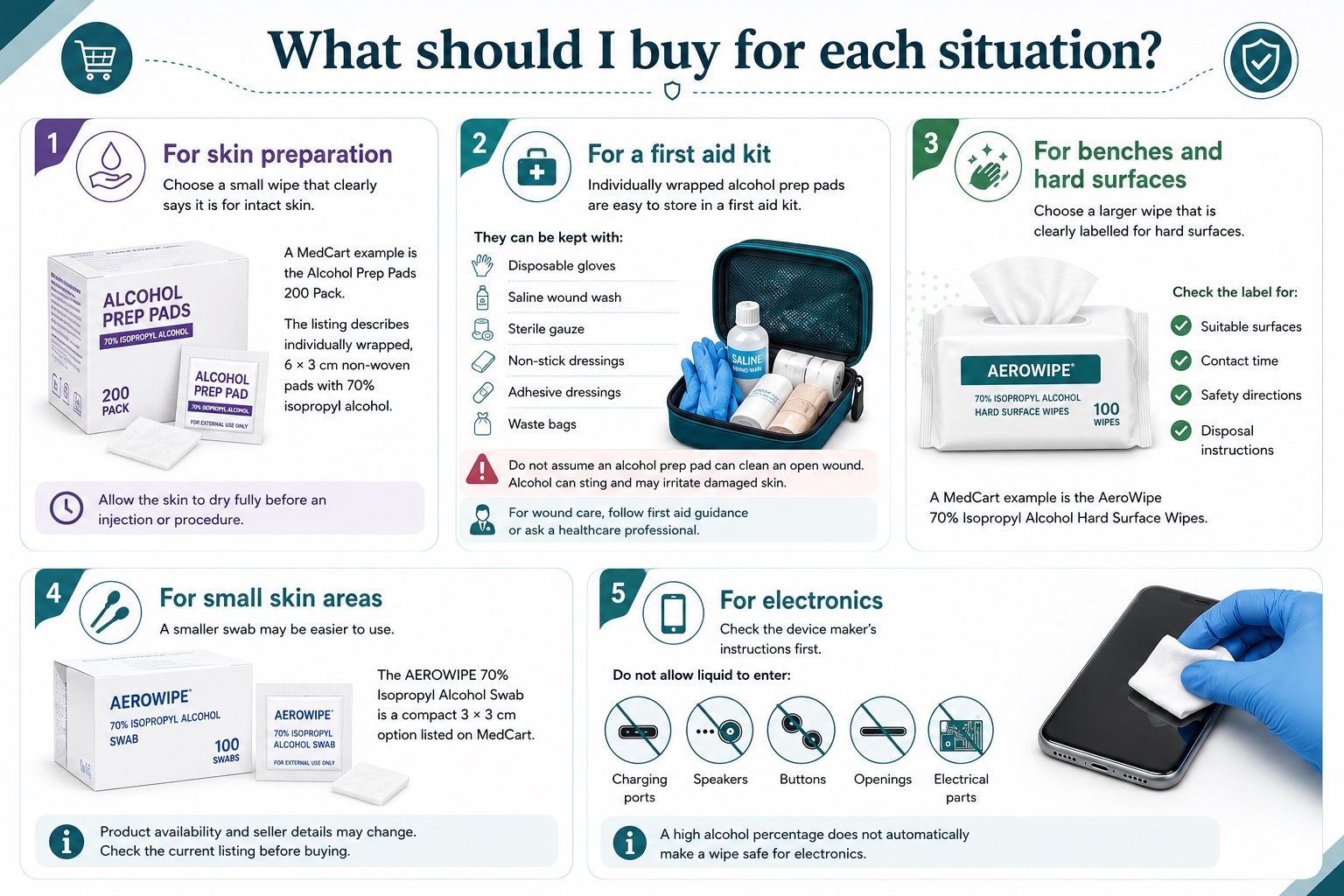
What should I buy for each situation?
For skin preparation
Choose a small wipe that clearly says it is for intact skin.
A MedCart example is the Alcohol Prep Pads 200 Pack. The listing describes individually wrapped, 6 × 3 cm non-woven pads with 70% isopropyl alcohol.
Allow the skin to dry fully before an injection or procedure.
For a first aid kit
Individually wrapped alcohol prep pads are easy to store in a first aid kit.
They can be kept with:
- Disposable gloves
- Saline wound wash
- Sterile gauze
- Non-stick dressings
- Adhesive dressings
- Waste bags
Do not assume an alcohol prep pad can clean an open wound. Alcohol can sting and may irritate damaged skin.
For wound care, follow first aid guidance or ask a healthcare professional.
For benches and hard surfaces
Choose a larger wipe that is clearly labelled for hard surfaces.
A MedCart example is the AeroWipe 70% Isopropyl Alcohol Hard Surface Wipes.
Check the label for:
- Suitable surfaces
- Contact time
- Safety directions
- Disposal instructions
For small skin areas
A smaller swab may be easier to use.
The AEROWIPE 70% Isopropyl Alcohol Swab is a compact 3 × 3 cm option listed on MedCart.
Product availability and seller details may change. Check the current listing before buying.
For electronics
Check the device maker’s instructions first.
Do not allow liquid to enter:
- Charging ports
- Speakers
- Buttons
- Openings
- Electrical parts
A high alcohol percentage does not automatically make a wipe safe for electronics.
How to use skin prep alcohol wipes
Always follow the product directions.
A simple process is:
- Check that the wipe is made for skin.
- Check the expiry date.
- Open the packet just before use.
- Wipe the required area.
- Let the skin air-dry fully.
- Do not touch the cleaned area.
- Place the used wipe in the correct bin.
Use each wipe only once.
How to use surface alcohol wipes
- Read the product label.
- Check that it is safe for the surface.
- Remove visible dirt first.
- Wipe the whole area.
- Keep the surface wet for the stated contact time.
- Use another wipe if the first one becomes dry or dirty.
- Allow the surface to dry as directed.
- Dispose of the wipe after use.
Contact time means how long the surface must stay wet. The time can be different for each product.
Do not mix alcohol wipes with other cleaners.
Alcohol wipe safety
Alcohol is flammable.
Keep alcohol wipes away from:
- Flames
- Cigarettes
- Candles
- Gas burners
- Sparks
- Heaters
- Hot surfaces
Safe Work Australia identifies isopropyl alcohol as a flammable liquid.
You should also:
- Use wipes in a place with fresh air.
- Avoid contact with the eyes and mouth.
- Never swallow the liquid.
- Keep wipes away from children and pets.
- Follow workplace safety rules.
- Read the Safety Data Sheet when using workplace products.
If someone swallows the liquid, call the Poisons Information Centre on 13 11 26.
Call 000 if the person collapses or stops breathing.
How to store alcohol wipes
- Keep them in their original pack.
- Close the lid after each use.
- Store them in a cool, dry place.
- Keep them away from sunlight and heat.
- Do not leave them in a hot car.
- Keep them out of reach of children.
- Check the expiry date.
- Do not use a damaged packet.
- Do not add water or alcohol to dry wipes.
Replace wipes that have dried out.
How to dispose of alcohol wipes
Used at home
Used wipes can usually go into general waste if they are not heavily contaminated and local rules allow it.
Never flush alcohol wipes down the toilet.
Wipes exposed to blood or body fluids
These may need to go into clinical waste.
Healthcare and care facilities should follow their waste policy and local laws.
Expired or unused alcohol products
Do not pour alcohol liquid into a sink, toilet or stormwater drain.
Ask your local council about household chemical disposal. In New South Wales, the EPA offers the Household Chemical CleanOut program.
Packaging
Only recycle the container if it is empty, dry and accepted by your local council.
Used wipes should not go into household recycling.
Quick buying checklist
Before buying alcohol wipes, ask:
- Is it for skin, hands, equipment or surfaces?
- What alcohol does it contain?
- What is the alcohol percentage?
- Is the wipe large enough for the job?
- Is the material soft, strong or low lint?
- Does it have clear directions?
- Does it list a contact time?
- Is it safe for my equipment?
- Is the pack properly sealed?
- When does it expire?
Frequently asked questions
Are alcohol wipes and alcohol swabs the same?
An alcohol swab is usually a small alcohol wipe made for a small area. Alcohol wipes can also include large surface-cleaning products.
Can I use a surface wipe on my skin?
No, unless the label clearly says it is safe for skin.
Can I use an alcohol wipe on an open wound?
Do not use one inside an open wound unless the product directions or a healthcare professional tell you to do so.
Are 99% alcohol wipes better than 70% wipes?
Not for every task. Choose the percentage and product made for your specific job.
Can alcohol wipes replace handwashing?
Not when your hands are visibly dirty. Use soap and water.
Can I reuse an alcohol wipe?
No. Alcohol wipes are made for single use.
Where to buy alcohol wipes in Australia
You can shop for alcohol wipes and medical supplies at MedCart Australia.
MedCart offers products for different needs, including:
- Alcohol prep pads
- Isopropyl alcohol swabs
- Hard-surface alcohol wipes
- Disposable gloves
- First aid supplies
- Gauze and dressings
- Cleaning products
Check the product’s intended use, size, alcohol percentage and availability before buying.
Visit MedCart Australia to compare alcohol wipes from Australian healthcare sellers.
References
- Australian Commission on Safety and Quality in Health Care. National Hand Hygiene Initiative. Accessed August 2026.
- Australian Commission on Safety and Quality in Health Care. Australian Guidelines for the Prevention and Control of Infection in Healthcare. Updated 2026.
- Therapeutic Goods Administration. Disinfectant Information for Consumers. Updated July 2024.
- Therapeutic Goods Administration. Understanding Regulation of Disinfectants, Sterilants and Sanitary Products. Updated September 2024.
- Australian Government Department of Health, Disability and Ageing. Australian Immunisation Handbook: Administration of Vaccines. Accessed August 2026.
- Safe Work Australia. Guide—Storage of Flammable Liquids.
- Safe Work Australia. Classifying Hazardous Chemicals: National Guide.
- Healthdirect Australia. Swallowed Substances. Accessed August 2026.
- NSW Environment Protection Authority. Household Chemical CleanOut. Accessed August 2026.
- NSW Health. Clinical Waste Management. Accessed August 2026.
This article provides general information only. Always follow the product label and seek professional advice for medical procedures or wound care.