Introduction
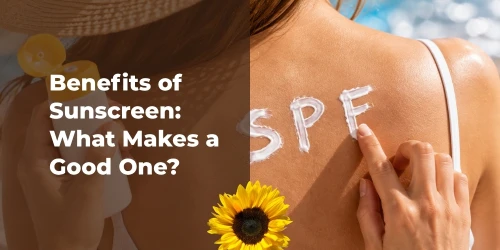
A good sunscreen does much more than help prevent a painful sunburn. It reduces the amount of ultraviolet, or UV, radiation that reaches exposed skin.
This is especially important in Australia. UV radiation can be strong even when the day is cool or cloudy. You cannot see or feel UV, so temperature is not a reliable guide.
According to the Australian Radiation Protection and Nuclear Safety Agency (ARPANSA), sun protection is recommended when the UV Index reaches 3 or above.
But sunscreen labels can be confusing. What does SPF50+ mean? Is broad spectrum important? What about PA++++? And which level of protection is enough for Australia?
Here is a simple guide to the benefits of sunscreen, what makes a good sunscreen and what to check before you buy.
What Are the Benefits of Sunscreen?
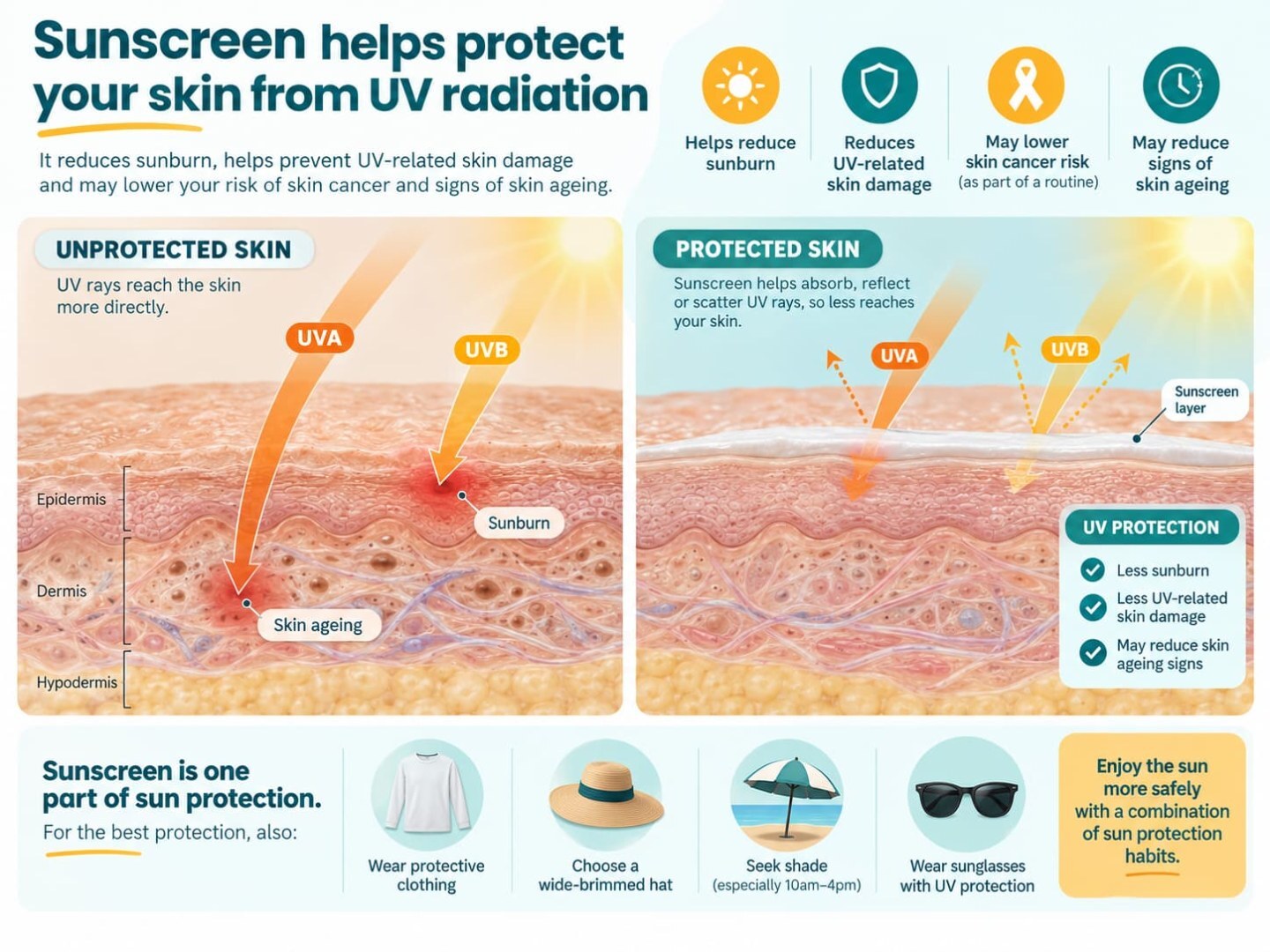
Sunscreen works by helping absorb, scatter or reflect UV radiation before too much reaches the skin.
Two types of UV radiation are important when choosing sun protection:
- UVA can contribute to skin ageing and skin cancer.
- UVB is the main cause of sunburn and can also contribute to skin cancer.
According to the Therapeutic Goods Administration (TGA), broad-spectrum sunscreen protects against both UVA and UVB radiation.
Why is sunscreen important?
When used correctly, sunscreen can help:
- reduce the chance of sunburn
- reduce the amount of UV radiation reaching the skin
- reduce cumulative UV-related skin damage
- form part of a routine that lowers skin cancer risk
- reduce some signs of sun-related skin ageing.
Australian research supports regular sunscreen use. A Queensland randomised trial reported fewer melanomas in the group assigned to daily sunscreen use than in the discretionary-use group during follow-up.
A separate Australian randomised trial found that participants assigned to daily sunscreen use showed less skin ageing over 4.5 years than those who used sunscreen at their own discretion.
Sunscreen should not be your only protection. Cancer Council Australia recommends combining sunscreen with protective clothing, a broad-brimmed hat, shade and sunglasses.
What Are the Qualities of a Good Sunscreen?
A good sunscreen needs to provide suitable UV protection, but it should also be easy enough to use correctly.
For Australian conditions, there are several useful things to look for.
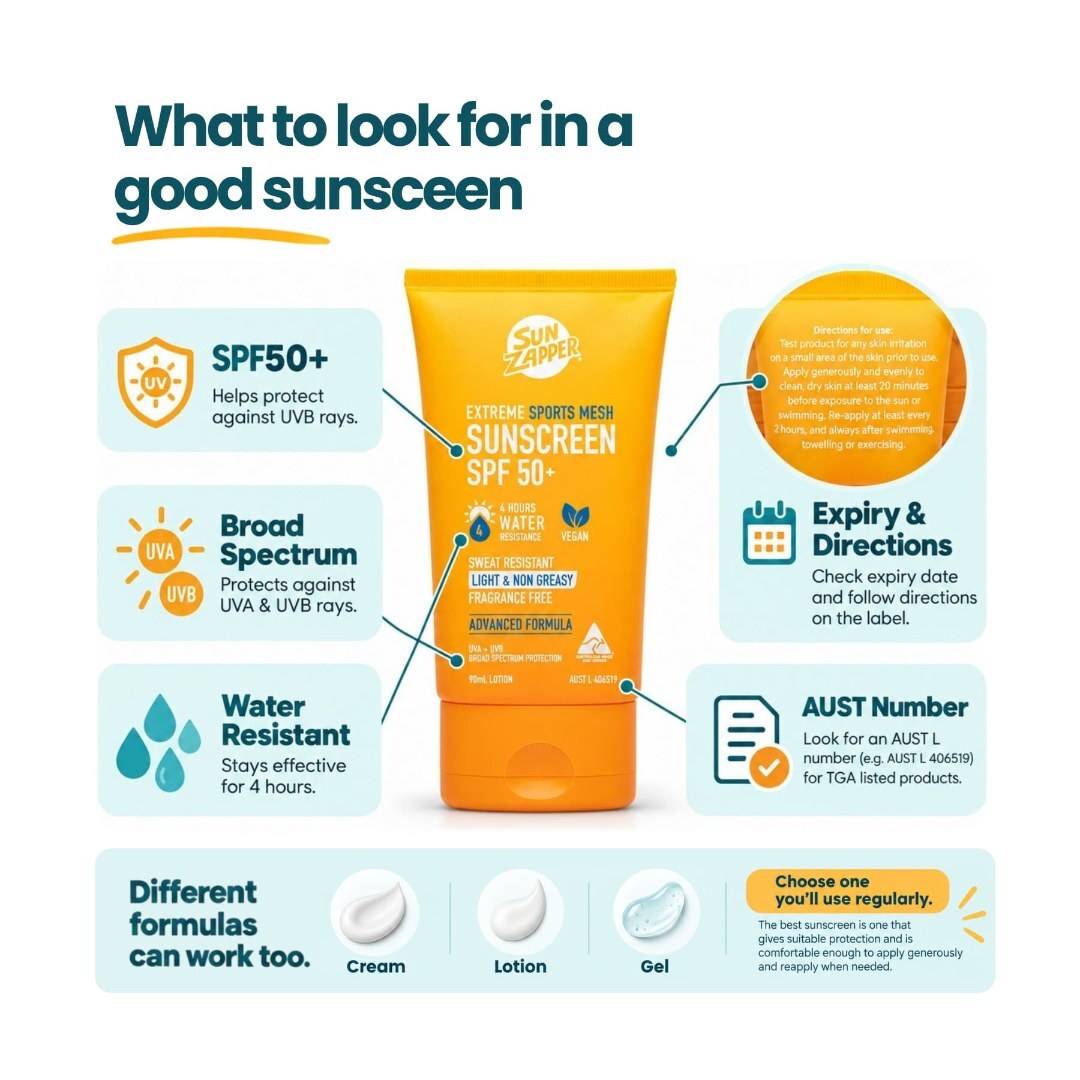
Cancer Council Australia recommends SPF50 or SPF50+, broad-spectrum and water-resistant sunscreen for maximum protection.
The TGA also recommends looking for an AUST identification number on therapeutic sunscreens. An AUST number means the sunscreen is included in the Australian Register of Therapeutic Goods and is regulated by the TGA.
Does the sunscreen type matter?
Creams, lotions and gels can all be useful if they meet the required standards and are applied correctly.
The formula also needs to suit the person using it. Someone with oily skin may prefer a lighter texture, while another person may prefer a cream.
The best sunscreen is not simply the bottle with the highest number. It should provide suitable protection and be something you are willing to apply generously and reapply when needed.
How to Read a Sunscreen Label: SPF, Broad Spectrum and PA
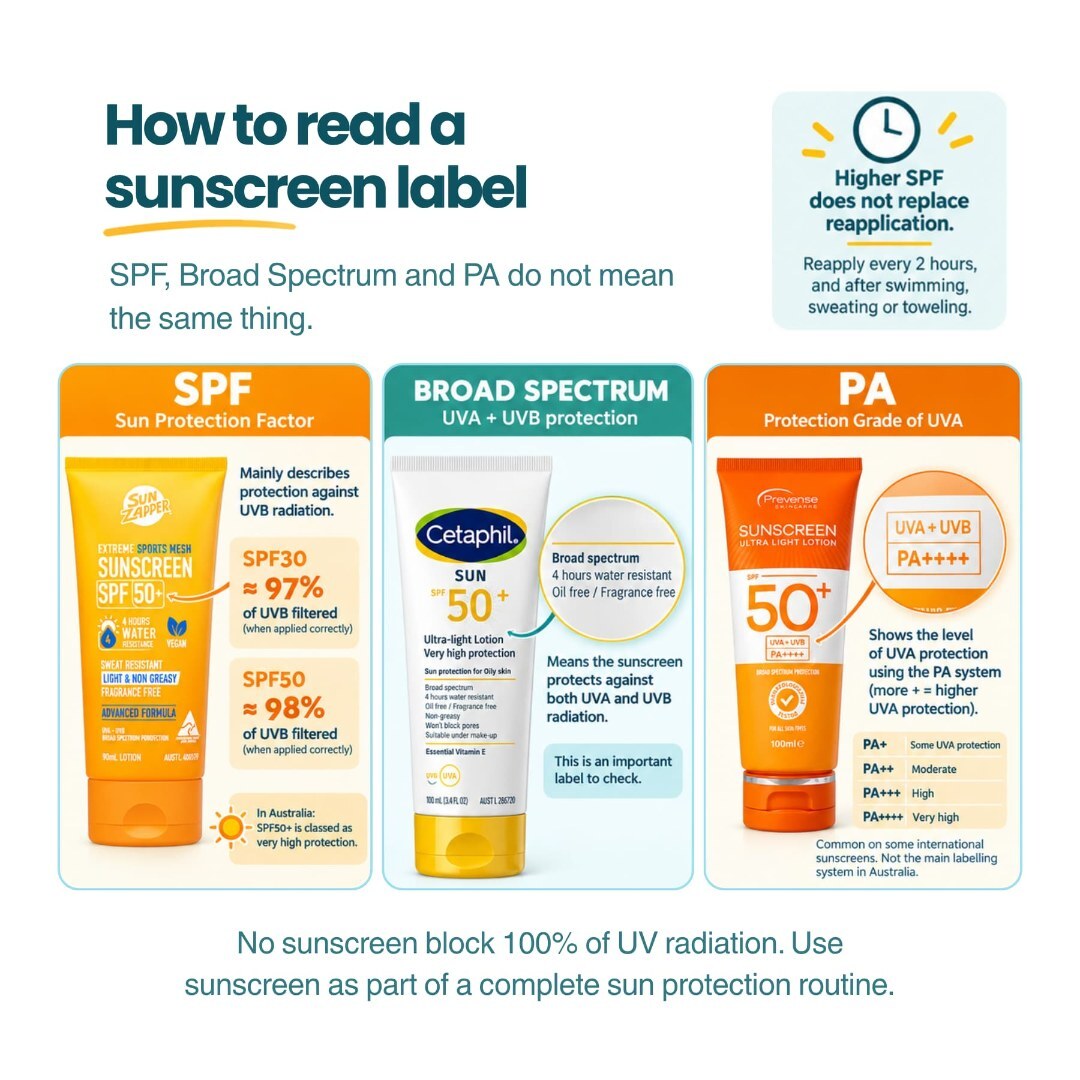
SPF, broad spectrum and PA do not mean the same thing. Each tells you something different about UV protection.
SPF rating
SPF means Sun Protection Factor.
The SPF number mainly describes protection against UVB radiation.
The TGA says that, when applied correctly, SPF30 sunscreen filters about 97% of UVB radiation, while SPF50 filters about 98%.
That difference may look small, but a higher SPF gives extra protection. This can be useful because people often apply less sunscreen than the amount used in sunscreen testing.
In Australia:
- SPF30, SPF40 and SPF50 are classed as high protection.
- SPF50+ is classed as very high protection.
- To carry an SPF50+ label, a sunscreen must achieve a tested SPF of at least 60.
SPF does not mean you can stay in the sun for an unlimited time.
Broad spectrum
Broad spectrum means protection against both UVA and UVB radiation.
This is one of the most important label terms to check.
A sunscreen may have a high SPF, but SPF mainly describes UVB protection. Broad-spectrum testing confirms that the product also provides the required UVA protection.
PA rating
You may also see PA+, PA++, PA+++ or PA++++, especially on sunscreens made for Asian markets.
PA means Protection Grade of UVA. The rating system was developed in Japan and is based on UVA protection testing. More plus signs indicate a higher level of measured UVA protection within that system.
However, PA is not the main sunscreen labelling system used in Australia.
For Australian consumers, PA can provide extra information, but it should not replace checking SPF and broad-spectrum protection.
Important Sunscreen Facts: What Is Enough for Australia?
So, which sunscreen is enough for Australia?
The TGA advises choosing SPF30 or higher. For maximum protection, Cancer Council Australia recommends SPF50 or SPF50+, broad-spectrum and water-resistant sunscreen.
For a simple everyday rule, SPF50 or SPF50+ broad-spectrum sunscreen is a strong choice when sun protection is needed.
However, the SPF on the bottle only tells part of the story. How you use sunscreen matters just as much.
How much sunscreen should you use?
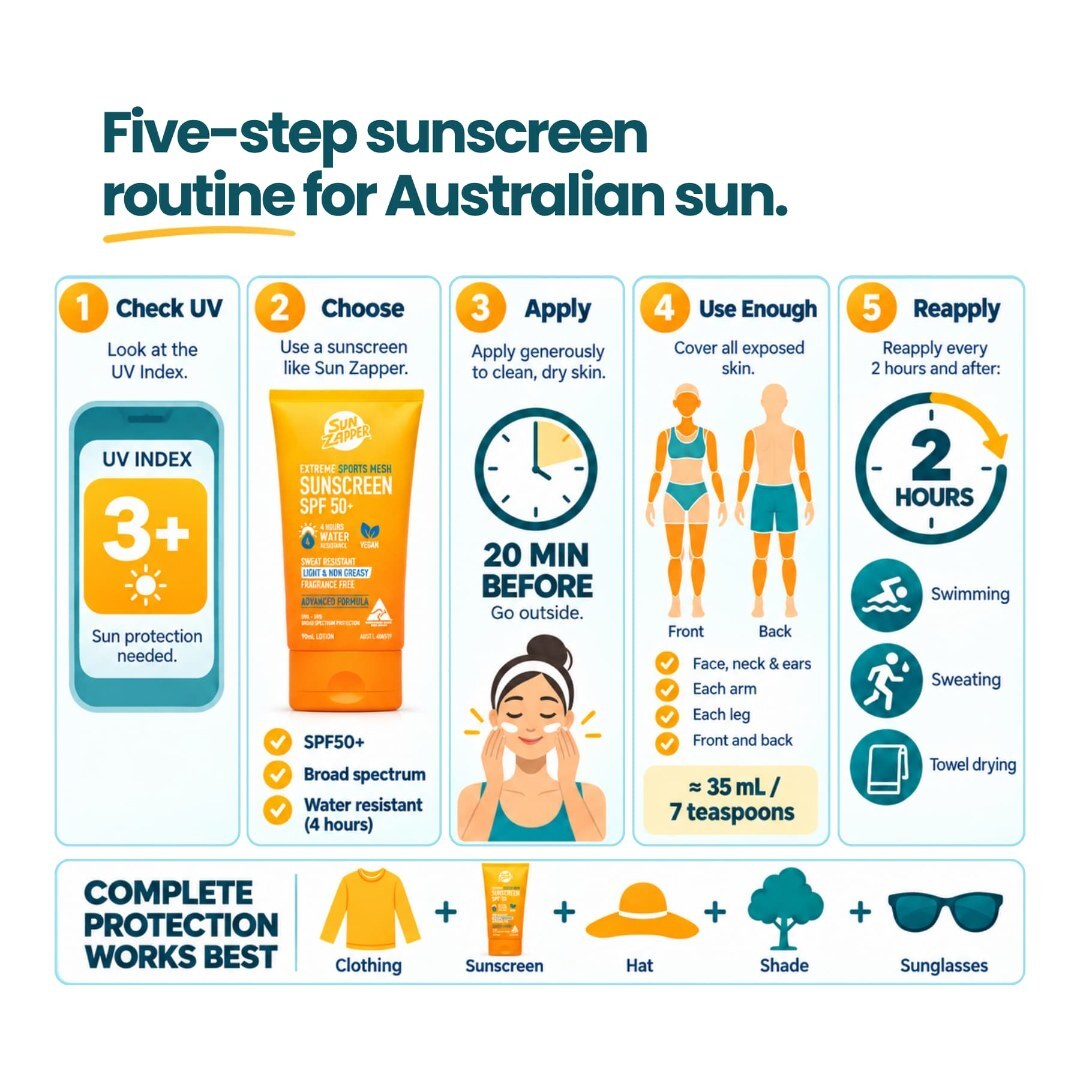
Cancer Council Australia recommends about 35 mL, or seven teaspoons, for a full-body application on an average adult.
That is roughly:
- 1 teaspoon for the face, neck and ears
- 1 teaspoon for each arm
- 1 teaspoon for each leg
- 1 teaspoon for the front of the body
- 1 teaspoon for the back of the body.
Apply sunscreen to clean, dry skin about 20 minutes before going outside.
Reapply at least every two hours, and reapply after swimming, sweating or towel drying.
Important facts to remember
- No sunscreen blocks 100% of UV radiation.
- Water resistant does not mean waterproof.
- Cool weather does not mean low UV.
- Clouds do not always mean UV is low.
- Using too little sunscreen reduces the protection you receive.
- Higher SPF does not mean you can stop reapplying.
- Check the UV Index rather than judging UV by heat or sunshine.
ARPANSA recommends sun protection when the UV Index is 3 or above.
At these UV levels, sunscreen should be used with the other SunSmart measures: protective clothing, a broad-brimmed hat, shade and sunglasses.
Frequently Asked Questions
Is SPF50 twice as protective as SPF25?
No. SPF numbers do not increase protection in a simple straight line.
According to the TGA, correctly applied SPF30 filters about 97% of UVB radiation, while SPF50 filters about 98%.
The important point is to use a suitable sunscreen generously and reapply it correctly.
Is broad-spectrum sunscreen important?
Yes. Broad spectrum means the sunscreen protects against both UVA and UVB radiation.
SPF mainly tells you about UVB protection, so checking for broad spectrum gives you important information about UVA protection too.
Is PA++++ better than SPF50+?
They measure different things.
SPF mainly describes UVB protection. PA describes UVA protection using another rating system.
A sunscreen can show both ratings, but Australian shoppers should not use PA as a replacement for SPF and broad-spectrum labelling.
Do I need sunscreen on a cloudy day?
Possibly. UV radiation cannot be judged by cloud, heat or brightness alone.
Check the UV Index. When it reaches 3 or above, ARPANSA and Cancer Council recommend sun protection.
Is water-resistant sunscreen waterproof?
No.
Swimming, sweating and towel drying can reduce the sunscreen left on your skin. Reapply after these activities even if the product is labelled water resistant.
Summary
The main benefits of sunscreen come from reducing the amount of UV radiation reaching your skin.
Used correctly, sunscreen can help reduce sunburn and cumulative UV damage. Research also supports regular sunscreen use as part of reducing skin cancer risk and limiting sun-related skin ageing.
For Australian conditions, remember four simple points:
SPF50 or SPF50+ + Broad Spectrum + Enough Sunscreen + Regular Reapplication
And when the UV Index is 3 or above, do not rely on sunscreen alone. Add protective clothing, a broad-brimmed hat, shade and sunglasses.
Where to Buy Sunscreen in Australia
You can explore sunscreen products on MedCart Australia.
When comparing products, check the SPF rating, broad-spectrum protection, water-resistance information, expiry date and directions for use. Choose a sunscreen that suits your needs and that you will be comfortable applying regularly.
For more health, wellness and personal-care products, visit MedCart Australia.
References
- Therapeutic Goods Administration (TGA). How to choose a sunscreen. Last updated 19 December 2025. Full URL: https://www.tga.gov.au/resources/explore-topic/sunscreens/how-choose-sunscreen
- Therapeutic Goods Administration (TGA). Reading sunscreen labels. Last updated 19 December 2025. Full URL: https://www.tga.gov.au/resources/explore-topic/sunscreens/reading-sunscreen-labels
- Therapeutic Goods Administration (TGA). How to use sunscreens. Last updated 19 December 2025. Full URL: https://www.tga.gov.au/resources/explore-topic/sunscreens/how-use-sunscreens
- Therapeutic Goods Administration (TGA). Sunscreen SPF testing – information for consumers. Last updated 4 May 2026. Full URL: https://www.tga.gov.au/resources/explore-topic/sunscreens/sunscreen-spf-testing-information-consumers
- Cancer Council Australia. Advice on how to choose, apply and store sunscreen. Publication date not stated. Full URL: https://www.cancer.org.au/cancer-information/causes-and-prevention/sun-safety/sunscreen/advice
- Cancer Council Australia. Fact sheet: Sunscreen. National Cancer Prevention Policy. Publication date not stated. Full URL: https://www.cancer.org.au/about-us/policy-and-advocacy/prevention/uv-radiation/related-resources/fact-sheet-sunscreen
- Cancer Council Australia. 5 S's of Sun Safety – Slip, Slop, Slap, Seek & Slide. Publication date not stated. Full URL: https://www.cancer.org.au/save-your-skin/five-sunsmart-steps
- Australian Radiation Protection and Nuclear Safety Agency (ARPANSA). How to use the ultraviolet radiation index charts. Publication date not stated. Full URL: https://www.arpansa.gov.au/our-services/monitoring/ultraviolet-radiation-monitoring/ultraviolet-radiation-index/how-use-uv
- Green AC, Williams GM, Logan V, Strutton GM. Journal of Clinical Oncology. Reduced melanoma after regular sunscreen use: randomized trial follow-up. Published online 6 December 2010; journal issue 20 January 2011. Full URL: https://pubmed.ncbi.nlm.nih.gov/21135266/
- Hughes MCB, Williams GM, Baker P, Green AC. Annals of Internal Medicine. Sunscreen and prevention of skin aging: a randomized trial. Published 4 June 2013. Full URL: https://pubmed.ncbi.nlm.nih.gov/23732711/
- Skin Health and Disease. Sunscreens: A Narrative Review. Published 2024. Used for information about international UVA rating systems, including the PA system. Full URL: https://pmc.ncbi.nlm.nih.gov/articles/PMC11608887/