
Quick Answer
The best hair dye depends on your hair type, hair condition, colour goal, and how long you want the colour to last.
For a small change, a temporary or semi-permanent hair dye may suit you.
For grey coverage or a long-lasting colour change, a permanent hair dye may be better.
For dry or damaged hair, a gentler colour option may be a better choice.
Always read the label first. Follow the instructions. Do a patch test before using hair dye, even if you have dyed your hair before.
What Is Hair Dye?
Hair dye is a product used to change the colour of hair.
It may be used to:
- Cover grey hair
- Change hair colour
- Refresh faded colour
- Add shine or tone
- Create highlights
- Make hair darker
- Make hair lighter
- Try a new look
Hair dye can be temporary or long-lasting. Some dyes wash out fast. Some last for weeks. Some stay until the hair grows out.
The best choice depends on your hair and your goal.
Is It Called Hair Dye or Hair Color?
Both terms are used.
In Australia and the UK, people often say hair dye or hair colour.
In the US, people often say hair color.
They usually mean the same thing.
For SEO, it is helpful to use both words in the article. But the main keyword for this article is hair dye.
What Type of Dye Is Best for Hair?
There is no single best hair dye for everyone.
The best type of dye depends on:
- Your natural hair colour
- Your hair texture
- Your hair condition
- Your scalp sensitivity
- How much grey hair you have
- How long you want the colour to last
- Whether you want to go lighter or darker
- Whether your hair has been bleached or treated before
A good rule is this:
Choose the least strong colour product that can give the result you want.
For example, if you only want a short-term colour change, you may not need permanent dye.
Main Types of Hair Dye
There are several common types of hair dye.
Each type works in a different way.
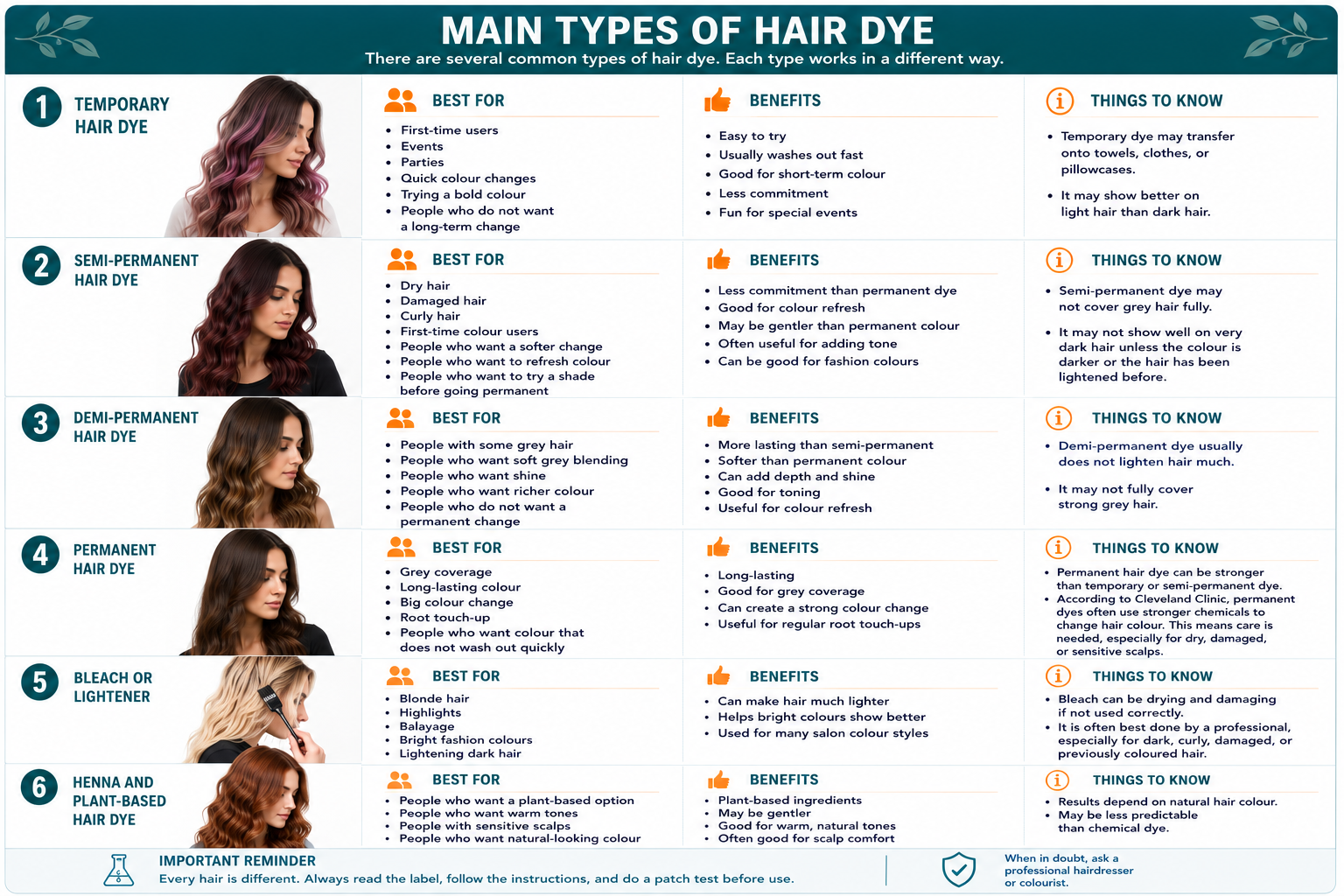
1. Temporary Hair Dye
Temporary hair dye sits on the outside of the hair.
It does not usually go deep into the hair strand. It often washes out after one or a few washes.
Best For
Temporary hair dye may suit:
- First-time users
- Events
- Parties
- Quick colour changes
- Trying a bold colour
- People who do not want a long-term change
Benefits
- Easy to try
- Usually washes out fast
- Good for short-term colour
- Less commitment
- Fun for special events
Things to Know
Temporary dye may transfer onto towels, clothes, or pillowcases.
It may show better on light hair than dark hair.
2. Semi-Permanent Hair Dye
Semi-permanent hair dye lasts longer than temporary dye.
It usually coats the hair and slowly fades with washing.
It may not lighten hair.
Best For
Semi-permanent hair dye may suit:
- Dry hair
- Damaged hair
- Curly hair
- First-time colour users
- People who want a softer change
- People who want to refresh colour
- People who want to try a shade before going permanent
Benefits
- Less commitment than permanent dye
- Good for colour refresh
- May be gentler than permanent colour
- Often useful for adding tone
- Can be good for fashion colours
Things to Know
Semi-permanent dye may not cover grey hair fully.
It may not show well on very dark hair unless the colour is darker or the hair has been lightened before.
3. Demi-Permanent Hair Dye
Demi-permanent hair dye is between semi-permanent and permanent dye.
It often uses a low-strength developer. It can help add colour or blend greys.
It usually fades over time.
Best For
Demi-permanent hair dye may suit:
- People with some grey hair
- People who want soft grey blending
- People who want shine
- People who want richer colour
- People who do not want a permanent change
Benefits
- More lasting than semi-permanent
- Softer than permanent colour
- Can add depth and shine
- Good for toning
- Useful for colour refresh
Things to Know
Demi-permanent dye usually does not lighten hair much.
It may not fully cover strong grey hair.
4. Permanent Hair Dye
Permanent hair dye changes the hair more deeply.
It is often used for long-lasting colour change and grey coverage.
Permanent dye can make hair darker. Some permanent dyes can also lighten natural hair, depending on the product and developer.
Best For
Permanent hair dye may suit:
- Grey coverage
- Long-lasting colour
- Big colour change
- Root touch-up
- People who want colour that does not wash out quickly
Benefits
- Long-lasting
- Good for grey coverage
- Can create a strong colour change
- Useful for regular root touch-ups
Things to Know
Permanent hair dye can be stronger than temporary or semi-permanent dye.
According to Cleveland Clinic, permanent dyes often use stronger chemicals to change hair colour. This means care is needed, especially for dry, damaged, or sensitive scalps.
5. Bleach or Lightener
Bleach is not the same as hair dye.
Bleach removes natural pigment from the hair. It is used to lighten hair before adding colour.
Best For
Bleach may be used for:
- Blonde hair
- Highlights
- Balayage
- Bright fashion colours
- Lightening dark hair
Benefits
- Can make hair much lighter
- Helps bright colours show better
- Used for many salon colour styles
Things to Know
Bleach can be drying and damaging if not used correctly.
It is often best done by a professional, especially for dark, curly, damaged, or previously coloured hair.
6. Henna and Plant-Based Hair Dye
Henna and plant-based dyes use natural or plant-based colour ingredients.
They may give red, brown, copper, or dark tones, depending on the product.
Best For
Plant-based hair dye may suit:
- People who want a plant-based option
- People who want warm tones
- People who prefer fewer synthetic ingredients
- People who do not need strong lightening
Benefits
- Plant-based option
- Can add rich warm tones
- May be useful for some sensitive users
Things to Know
Plant-based does not always mean allergy-free.
The FDA and other safety sources warn that hair dyes can cause allergic reactions. This can happen even if the product seems gentle or natural.
Always do a patch test.
Best Hair Dye for Each Hair Type
Different hair types may need different colour care.
Below is a simple guide.
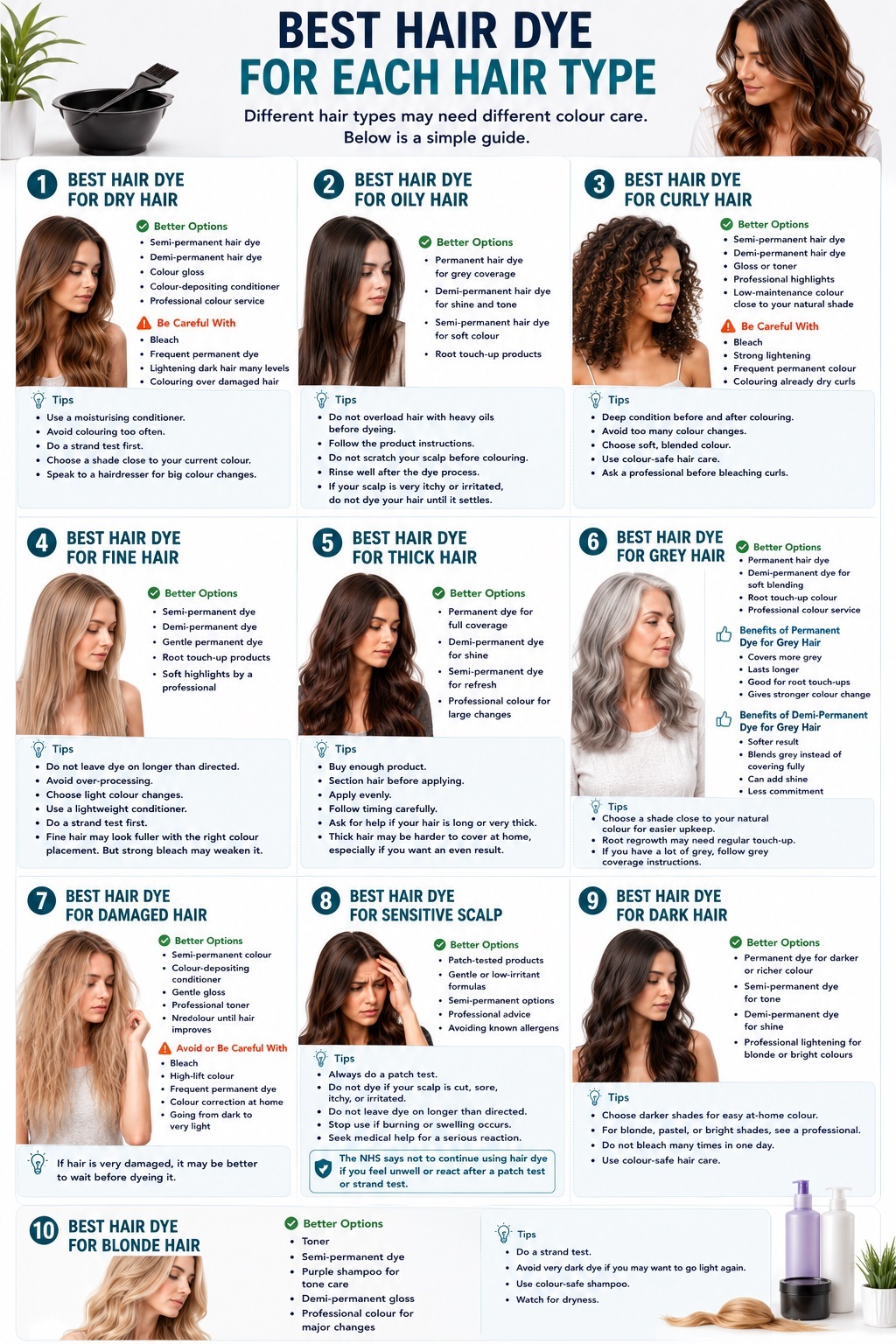
Best Hair Dye for Dry Hair
Dry hair needs gentle care.
If your hair feels rough, frizzy, or brittle, strong colour products may make it feel drier.
Better Options
- Semi-permanent hair dye
- Demi-permanent hair dye
- Colour gloss
- Colour-depositing conditioner
- Professional colour service
Be Careful With
- Bleach
- Frequent permanent dye
- Lightening dark hair many levels
- Colouring over damaged hair
Tips
- Use a moisturising conditioner.
- Avoid colouring too often.
- Do a strand test first.
- Choose a shade close to your current colour.
- Speak to a hairdresser for big colour changes.
Best Hair Dye for Oily Hair
Oily hair can still use most types of hair dye.
The main issue is scalp oil and product build-up.
Better Options
- Permanent hair dye for grey coverage
- Demi-permanent hair dye for shine and tone
- Semi-permanent hair dye for soft colour
- Root touch-up products
Tips
- Do not overload hair with heavy oils before dyeing.
- Follow the product instructions.
- Do not scratch your scalp before colouring.
- Rinse well after the dye process.
If your scalp is very itchy or irritated, do not dye your hair until it settles.
Best Hair Dye for Curly Hair
Curly hair can be more prone to dryness.
Because of this, gentle colour choices may be better.
Better Options
- Semi-permanent hair dye
- Demi-permanent hair dye
- Gloss or toner
- Professional highlights
- Low-maintenance colour close to your natural shade
Be Careful With
- Bleach
- Strong lightening
- Frequent permanent colour
- Colouring already dry curls
Tips
- Deep condition before and after colouring.
- Avoid too many colour changes.
- Choose soft, blended colour.
- Use colour-safe hair care.
- Ask a professional before bleaching curls.
Best Hair Dye for Fine Hair
Fine hair can be more delicate.
It may process colour faster than thick hair.
Better Options
- Semi-permanent dye
- Demi-permanent dye
- Gentle permanent dye
- Root touch-up products
- Soft highlights by a professional
Tips
- Do not leave dye on longer than directed.
- Avoid over-processing.
- Choose light colour changes.
- Use a lightweight conditioner.
- Do a strand test first.
Fine hair may look fuller with the right colour placement. But strong bleach may weaken it.
Best Hair Dye for Thick Hair
Thick hair may need more product and more time to apply colour evenly.
Better Options
- Permanent dye for full coverage
- Demi-permanent dye for shine
- Semi-permanent dye for refresh
- Professional colour for large changes
Tips
- Buy enough product.
- Section hair before applying.
- Apply evenly.
- Follow timing carefully.
- Ask for help if your hair is long or very thick.
Thick hair may be harder to cover at home, especially if you want an even result.
Best Hair Dye for Grey Hair
Grey hair can be harder to cover.
Permanent dye is often used for stronger grey coverage.
Better Options
- Permanent hair dye
- Demi-permanent dye for soft blending
- Root touch-up colour
- Professional colour service
Benefits of Permanent Dye for Grey Hair
- Covers more grey
- Lasts longer
- Good for root touch-ups
- Gives stronger colour change
Benefits of Demi-Permanent Dye for Grey Hair
- Softer result
- Blends grey instead of covering fully
- Can add shine
- Less commitment
Tips
- Choose a shade close to your natural colour for easier upkeep.
- Root regrowth may need regular touch-up.
- If you have a lot of grey, follow grey coverage instructions.
Best Hair Dye for Damaged Hair
Damaged hair needs extra care.
Hair may be damaged if it feels:
- Dry
- Weak
- Stretchy
- Brittle
- Rough
- Frizzy
- Easy to break
Better Options
- Semi-permanent colour
- Colour-depositing conditioner
- Gentle gloss
- Professional toner
- No colour until hair improves
Avoid or Be Careful With
- Bleach
- High-lift colour
- Frequent permanent dye
- Colour correction at home
- Going from dark to very light
If hair is very damaged, it may be better to wait before dyeing it.
Best Hair Dye for Sensitive Scalp
A sensitive scalp may react to some hair dye ingredients.
The FDA says some hair dyes can cause allergic reactions. It also says people can develop sensitivities over time, even if they used hair dye before without a problem.
Better Options
- Patch-tested products
- Gentle or low-irritant formulas
- Semi-permanent options
- Professional advice
- Avoiding known allergens
Tips
- Always do a patch test.
- Do not dye if your scalp is cut, sore, itchy, or irritated.
- Do not leave dye on longer than directed.
- Stop use if burning or swelling occurs.
- Seek medical help for a serious reaction.
The NHS says not to continue using hair dye if you feel unwell or react after a patch test or strand test.
Best Hair Dye for Dark Hair
Dark hair can be harder to lighten.
If you want to go lighter, bleach or lightener may be needed.
Better Options
- Permanent dye for darker or richer colour
- Semi-permanent dye for tone
- Demi-permanent dye for shine
- Professional lightening for blonde or bright colours
Tips
- Choose darker shades for easy at-home colour.
- For blonde, pastel, or bright shades, see a professional.
- Do not bleach many times in one day.
- Use colour-safe hair care.
Best Hair Dye for Blonde Hair
Blonde hair may show colour easily.
It may also stain or turn uneven if the wrong colour is used.
Better Options
- Toner
- Semi-permanent dye
- Purple shampoo for tone care
- Demi-permanent gloss
- Professional colour for major changes
Tips
- Do a strand test.
- Avoid very dark dye if you may want to go light again.
- Use colour-safe shampoo.
- Watch for dryness.
Which Hair Dye Is Best?
The best hair dye is the one that matches your hair goal and hair condition.
Here is a simple guide:
If you are unsure, start with a softer option first.
Is Hair Dye Good for Your Hair?
Hair dye is used to change colour. It is not usually used to improve hair health.
Some colour products may include conditioners or shine ingredients. These may help hair feel smoother for a time.
But dyeing hair can also cause dryness, irritation, or damage, especially if used often or incorrectly.
Permanent dye and bleach can be stronger than temporary colour. They may change the hair structure more.
If your hair is already dry or damaged, take care before colouring.
Can Hair Dye Damage Hair?
Hair dye can damage hair, especially when used often or when lightening is involved.
Damage may show as:
- Dryness
- Frizz
- Breakage
- Rough texture
- Split ends
- Dull colour
- Hair feeling weak
To reduce the risk:
- Follow the instructions.
- Do not leave dye on too long.
- Do not colour too often.
- Use conditioner.
- Avoid repeated bleaching.
- Do a strand test.
- Ask a professional for big colour changes.
Can Hair Dye Cause Allergies?
Yes. Hair dye can cause allergic reactions in some people.
The FDA says some hair dyes can cause allergic reactions or sensitisation. A person may react even if they have used hair dye before.
This is why a patch test is important before each use.
Possible signs of a reaction include:
- Itching
- Burning
- Redness
- Swelling
- Rash
- Blisters
- Face swelling
- Trouble breathing
Seek urgent help if you have trouble breathing, swelling of the face or throat, or a serious reaction.
How to Do a Patch Test
Always follow the product instructions.
A general patch test may involve:
- Applying a small amount of product to a small area of skin.
- Leaving it for the time listed in the instructions.
- Watching for redness, itching, burning, swelling, or rash.
- Not using the product if a reaction appears.
Do not skip this step.
Even if you used the same brand before, a reaction can still happen.
How to Do a Strand Test
A strand test checks how the colour may look on your hair.
This is helpful because hair colour can look different on each person.
To do a strand test:
- Choose a small hidden section of hair.
- Apply the dye as directed.
- Wait for the listed time.
- Rinse and dry.
- Check the colour result.
This can help you avoid a colour result you do not like.
How to Choose the Right Shade
When choosing hair dye, think about:
- Your natural hair colour
- Your skin tone
- Your eye colour
- How much grey you have
- How much upkeep you want
- Whether you want warm or cool tones
- Whether you want a natural or bold look
If you want low maintenance, choose a shade close to your natural hair colour.
If you want a big change, it may be safer to see a professional.
Warm vs Cool Hair Colour
Hair dye shades often have warm or cool tones.
Warm Tones
Warm tones may include:
- Golden blonde
- Copper
- Auburn
- Warm brown
- Caramel
Cool Tones
Cool tones may include:
- Ash blonde
- Ash brown
- Beige blonde
- Cool black
- Silver
If your hair turns too yellow or orange, a toner may help. Ask a hair professional if you are unsure.
At-Home Hair Dye vs Salon Hair Colour
At-home hair dye can be convenient. It may suit simple colour changes and root touch-ups.
Salon hair colour may be better for:
- Bleaching
- Highlights
- Colour correction
- Going much lighter
- Damaged hair
- Curly hair
- Big colour changes
- Uneven colour
- Sensitive scalp concerns
A hairdresser can check your hair condition and choose a safer colour plan.
Hair Dye Safety Tips
Before using hair dye:
- Read the instructions.
- Do a patch test.
- Do a strand test.
- Wear gloves.
- Protect clothing and towels.
- Do not dye eyebrows or eyelashes unless the product says it is safe.
- Do not use on broken or irritated skin.
- Do not mix products unless the instructions say to.
- Do not leave dye on longer than directed.
- Rinse well.
- Keep away from children.
Hair Dye Aftercare Tips
After dyeing your hair:
- Use colour-safe shampoo.
- Use conditioner.
- Avoid washing too often.
- Use heat tools less often.
- Protect hair from too much sun.
- Avoid chlorine where possible.
- Use a hair mask if your hair feels dry.
- Touch up roots only when needed.
Good aftercare can help colour look better for longer.
Common Hair Dye Mistakes
Mistake 1: Skipping the Patch Test
Always do a patch test before using hair dye.
Mistake 2: Choosing a Shade Too Far From Your Hair Colour
Big colour changes are harder to do at home.
Mistake 3: Leaving Dye On Too Long
More time does not always mean better colour. It may increase irritation or damage.
Mistake 4: Dyeing Damaged Hair
Damaged hair may absorb colour unevenly.
Mistake 5: Not Buying Enough Product
Long or thick hair may need more than one box.
Mistake 6: Expecting Dark Hair to Turn Blonde Easily
Dark hair usually needs lightening before it can become blonde or pastel.
Frequently Asked Questions
What type of dye is best for hair?
The best type depends on your goal. Temporary dye is good for short-term colour. Semi-permanent dye is good for soft colour. Permanent hair dye is often used for long-lasting colour and grey coverage.
Is it called hair dye or hair color?
Both terms are used. “Hair dye” and “hair colour” usually mean the same thing. In Australia, “hair colour” is common, but “hair dye” is also widely used.
Which hair dye is best?
The best hair dye is the one that suits your hair type, colour goal, and scalp needs. For damaged hair, a gentler semi-permanent option may be better. For strong grey coverage, permanent dye may be more suitable.
Is hair dye good for your hair?
Hair dye changes hair colour. It is not mainly used to improve hair health. Some products may make hair feel smooth, but dyeing can also cause dryness, irritation, or damage if not used correctly.
What hair dye is best for grey hair?
Permanent hair dye is often used for stronger grey coverage. Demi-permanent dye may help blend grey hair for a softer look.
What hair dye is best for curly hair?
Curly hair may suit semi-permanent or demi-permanent dye because curls can be more prone to dryness. Be careful with bleach and strong lightening.
What hair dye is best for damaged hair?
A gentle semi-permanent colour, gloss, or colour-depositing conditioner may be a better option. Very damaged hair may need rest before dyeing.
Can I dye my hair if my scalp is itchy?
It is better not to dye your hair if your scalp is itchy, sore, broken, or irritated. Wait until your scalp is calm, or ask a health professional.
Can hair dye cause a rash?
Yes. Some people can react to hair dye. Always do a patch test before use.
How often can I dye my hair?
This depends on the dye type and your hair condition. Avoid dyeing too often, especially with bleach or permanent dye. Follow the product guide and ask a professional if unsure.
Simple Summary
The best hair dye depends on your hair type and colour goal.
For short-term colour, try temporary dye.
For soft colour, try semi-permanent dye.
For shine and tone, try demi-permanent dye.
For grey coverage, permanent dye may be better.
For big lightening, see a professional.
Always do a patch test. Follow the instructions. Do not use hair dye on irritated skin or a sore scalp.
Where to Buy Hair Dye
If you are looking for hair dye, hair colour, root touch-up products, or hair care items, you can browse hair dye and colour products at MedCart Australia.
Shop hair dye products here: Hair Dye and Colour
MedCart Australia offers a wide range of beauty, wellness, hair care, personal care, healthcare, and medical products for Australian customers.
Visit MedCart Australia here: MedCart Australia
References
This article used information from reliable sources, including:
- U.S. Food and Drug Administration: Hair Dyes
- Cleveland Clinic: Hair dye safety and salon vs box dye guidance
- NHS: Hair dye reactions
- National Cancer Institute: Hair dyes and cancer risk fact sheet
- American Cancer Society: Hair dyes and cancer risk